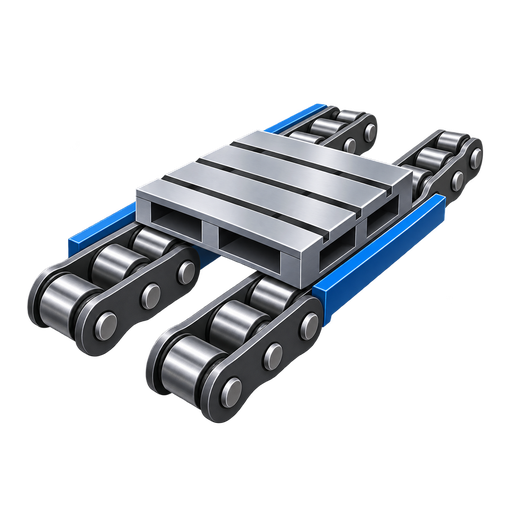
Double Plus Chain Working Principle Explained
Practical engineering guide: Double Plus Chain Working Principle Explained. Selection, interfaces, application checks, maintenance and RFQ inputs.
This guide focuses on how the small and large roller arrangement creates free-flow carrier motion and a speed relationship between chain and pallet. It is written for machine builders, maintenance teams and buyers who need a chain selection that can be checked against drawings and the real conveyor rather than a generic product label.
Double Plus Chain Working Principle Explained
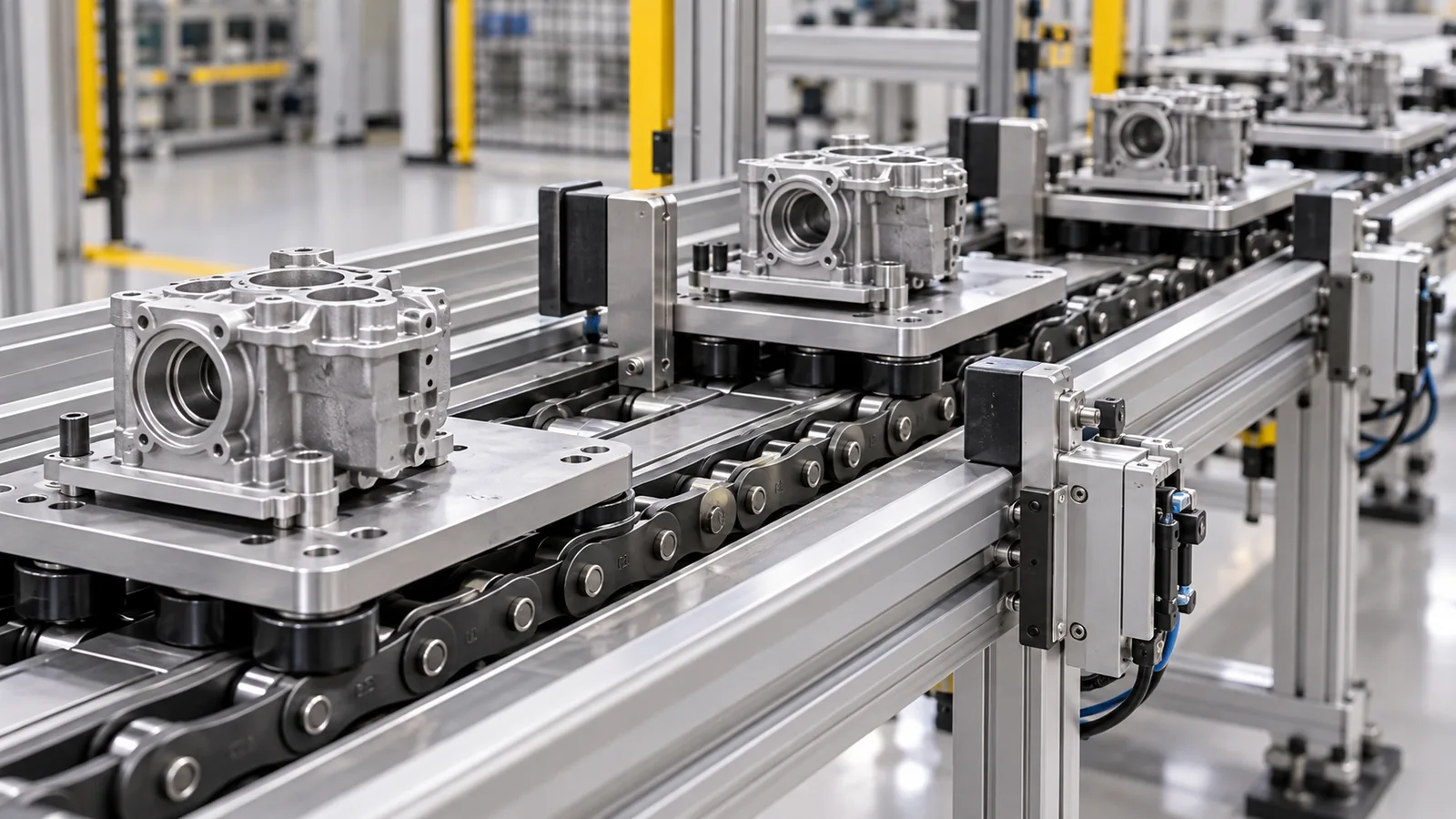
The most useful way to evaluate this subject is to treat the chain as one part of a complete carrier-transport mechanism. In a typical project such as a workpiece pallet moving between assembly stations, chain pitch, roller contact, rail alignment, sprocket engagement, carrier stiffness, stops and maintenance access all influence the result. A useful engineering review therefore combines model-level data with the operating sequence of the machine.
Mengapa isu ini penting
How the small and large roller arrangement creates free-flow carrier motion and a speed relationship between chain and pallet affects more than catalogue selection. It changes how the workpiece carrier enters a station, how loads pass into guide rails, how the chain approaches the drive and how the system behaves during stopping or accumulation. If one interface is ignored, the symptom may appear somewhere else: a roller can wear because a rail joint is high, a chain can pull sideways because a pallet stop is offset, or a new chain can run badly because the old sprocket is worn.
The practical objective is not to eliminate every variation in the machine. It is to identify the variables that must be controlled, define which dimensions are fixed by the chain source, and leave unsupported items for explicit RFQ confirmation. This is also why treating the 2.5x or 3.0x ratio as a motor-speed setting is a risky shortcut. It replaces measurable machine data with an assumption and can make a correct-looking part fail at installation.
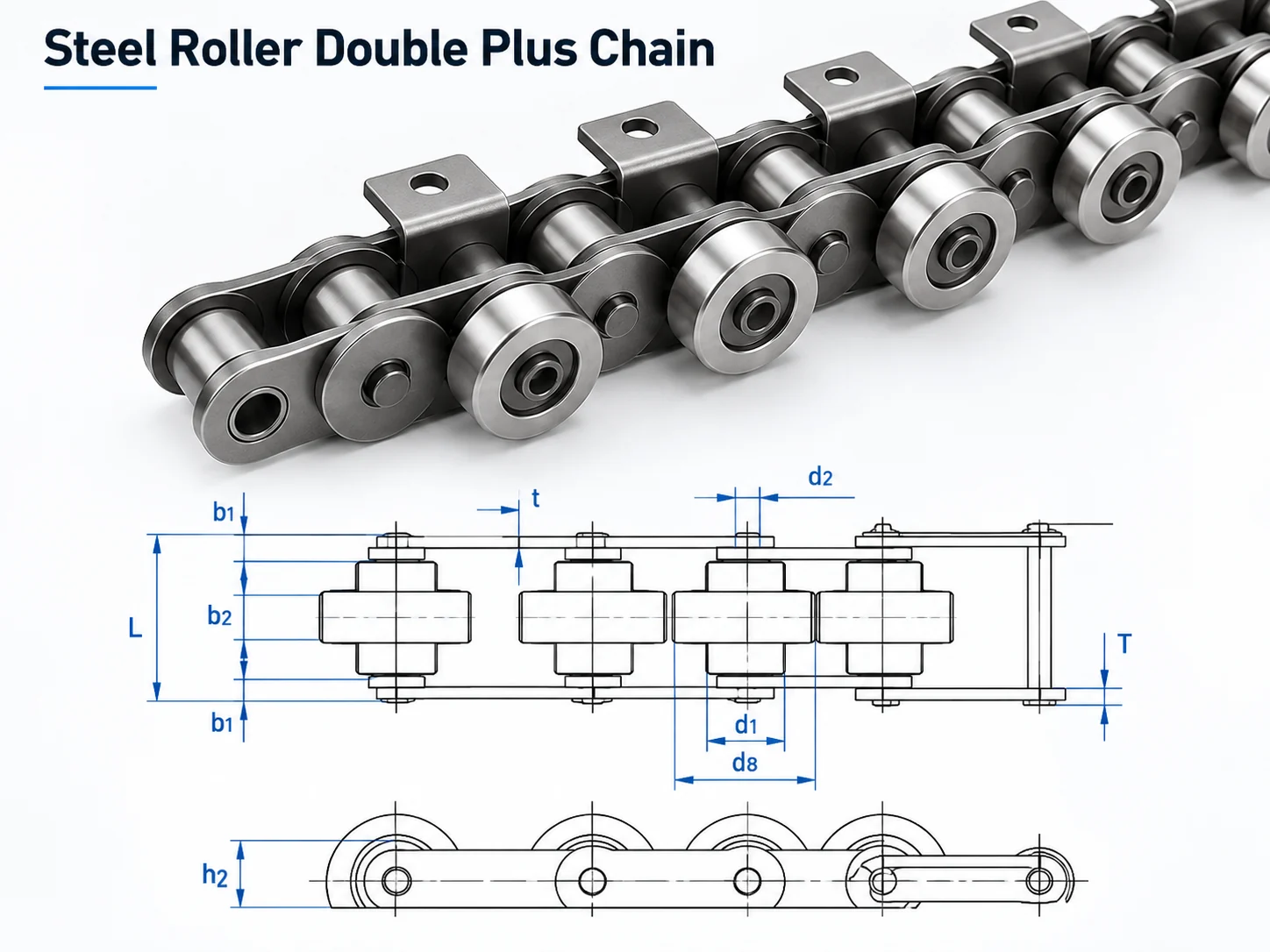
In the approved catalogue used for this project, the Double Plus family is presented in 2.5-times and 3-times speed groups. That description supports the speed-ratio concept, but it does not remove the need to check the model-specific data row. A BS25 and BS30 chain can share a nominal pitch while having different roller geometry, so the complete row and drawing remain the authority for replacement work.
Empat semakan untuk ditakrifkan dahulu
Small/Large Roller Contact
Record the relevant diameter, offset, contact surface, clearance and visible wear so the running interface can be checked.
Rail Support
Record the relevant diameter, offset, contact surface, clearance and visible wear so the running interface can be checked.
Pallet Contact Surface
Define the loaded condition, contact or datum surface, position and force path so the carrier interface can be checked.
Sprocket And Return Path
Record tooth count or drive geometry, shaft alignment, take-up position and the way the chain enters and leaves the drive.
Mulakan dengan geometri rantai yang tepat
Apabila nombor model tersedia, gunakan spesifikasi model yang tepat dan lukisan yang sepadan. Bandingkan pic, diameter penggelek, lebar dalam, diameter dan panjang pin, ketinggian dan ketebalan plat, dan sebarang dimensi penggelek sisi, penggelek besar atau pin berongga yang bersentuhan dengan penghantar. Apabila kod tidak diketahui, ukur rantai yang dipasang secara sistematik. Mengukur pic merentasi beberapa pin adalah lebih andal daripada membaca satu jurang haus, dan gambar hendaklah menunjukkan profil sisi, susunan penggelek, gegancu dan sentuhan rel.
Do not use tensile strength as the pallet payload. Catalogue tensile figures are material/component test properties. Conveyor working conditions also involve line length, the number of chain strands, carrier count, acceleration, shock, friction, lubrication, sprocket size, wear state and the required safety factor. The chain can only be verified for a system after those conditions are understood.
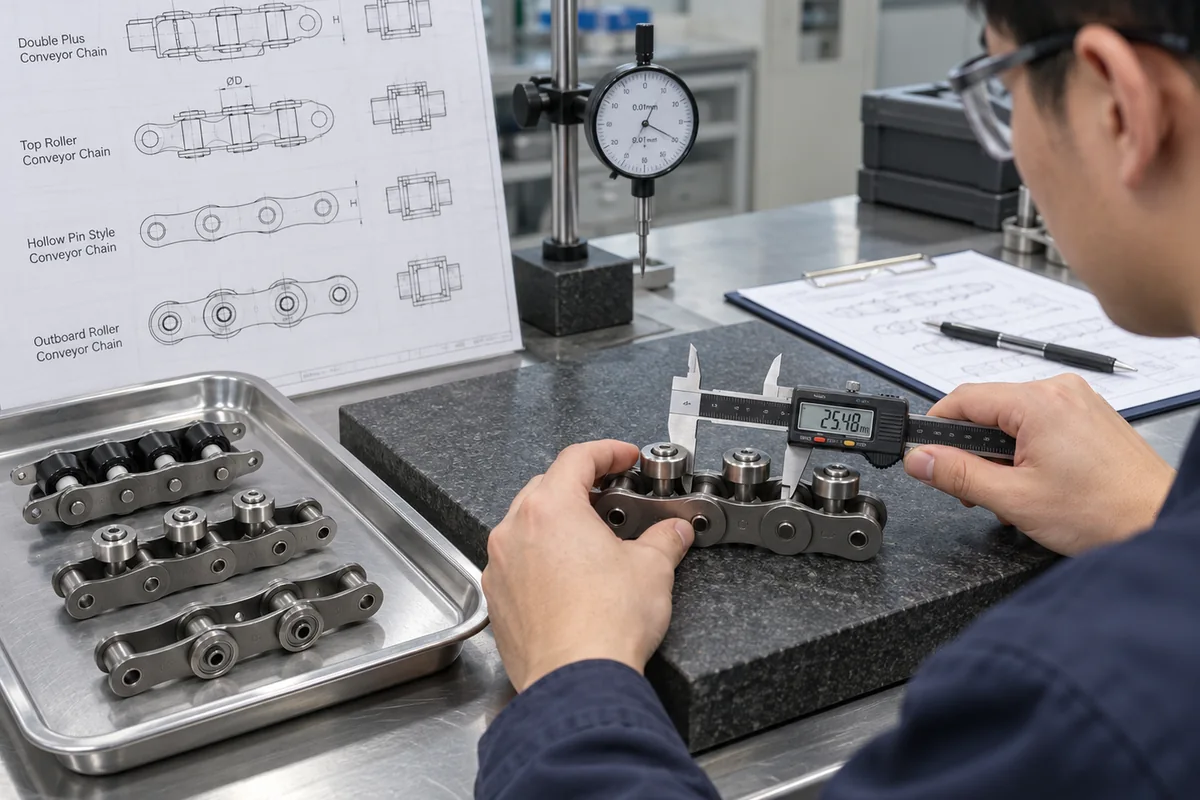
Aliran kerja pemilihan
- Small/Large Roller Contact: bandingkan keadaan yang diperlukan dengan lukisan rantai atau susun atur sistem yang tepat dan rekodkan sebarang soalan terbuka untuk pengesahan RFQ.
- Rail Support: bandingkan keadaan yang diperlukan dengan lukisan rantai atau susun atur sistem yang tepat dan rekodkan sebarang soalan terbuka untuk pengesahan RFQ.
- Pallet Contact Surface: bandingkan keadaan yang diperlukan dengan lukisan rantai atau susun atur sistem yang tepat dan rekodkan sebarang soalan terbuka untuk pengesahan RFQ.
- Sprocket And Return Path: bandingkan keadaan yang diperlukan dengan lukisan rantai atau susun atur sistem yang tepat dan rekodkan sebarang soalan terbuka untuk pengesahan RFQ.
- Pembawa dan tugas: rekod jisim pembawa yang dimuatkan, bilangan pembawa, kelajuan talian, permulaan sejam, corak pengumpulan dan sebarang peralihan condong atau menegak.
- Memandu dan pulang: sahkan data gegancu, penjajaran aci, jarak pengambilan, sokongan pemulangan dan akses pelinciran.
- Keadaan pelepasan: senaraikan mana-mana medan yang tidak dinyatakan dalam data teknikal—seperti gred bahan khas, salutan, beban sistem yang dibenarkan atau penarafan persekitaran—sebagai item pengesahan RFQ dan bukannya menganggarkannya.
Integrasi sistem
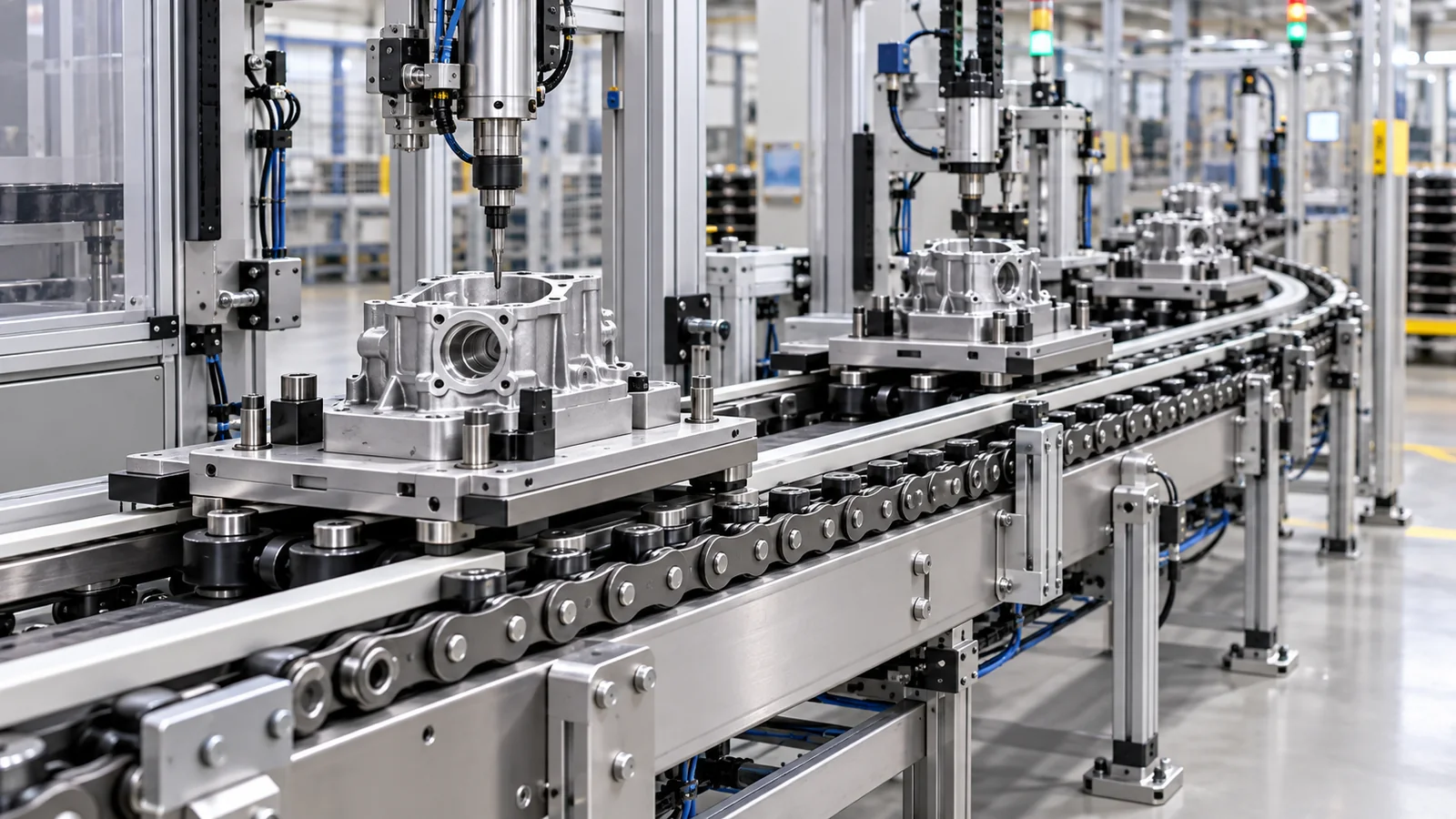
Setelah rantai dikenal pasti, periksa bagaimana penghantar memindahkan beban ke seluruh mesin. Rel panduan atau haus harus menyokong permukaan penggelek yang dimaksudkan dan kekal berterusan melalui sambungan. Untaian selari harus mempunyai jarak tengah yang ditentukan dan pemasaan pemacu yang disegerakkan. Penahan harus bersentuhan dengan permukaan palet yang direka bentuk, bukan plat sisi rantai. Pemindahan silang dan pengangkatan memerlukan sokongan yang mencukupi supaya pembawa tidak jatuh ke dalam jurang atau mendarat di tepi pin/plat.
Bagi sistem yang terkumpul, asingkan pengangkutan daripada pemberhentian. Rantai mungkin terus bergerak semasa pembawa dipegang, tetapi daya pemberhentian, panjang giliran, jujukan mula semula dan geseran setempat masih perlu diperiksa. Bagi sistem yang meletakkan benda kerja untuk pemprosesan, gunakan ciri lokasi khusus apabila kebolehulangan yang diperlukan lebih ketat daripada yang boleh disediakan oleh pengangkutan penghantar biasa.
Pentauliahan dan penyelenggaraan
Mula-mula, gunakan penghantar baharu atau yang telah dibaiki pada kelajuan rendah. Lakukan beberapa litar rantai lengkap dan perhatikan pacuan, pemulangan, peralihan rel, hentian dan pemindahan. Dengar bunyi yang berulang sekali setiap pusingan rantai atau sekali setiap putaran gegancu kerana corak tersebut membantu mengasingkan sambungan yang ketat, kerosakan penggelek, langkah rel setempat atau masalah gegancu. Dengan palet bahan kerja yang tegar, perhatikan kecondongan merentasi untaian selari; perbezaan masa yang kecil pun boleh membebankan satu sisi pembawa.
Penyelenggaraan harus menjejaki trend dan bukannya menunggu kegagalan. Rekodkan pemeriksaan pemanjangan atau panjang menggunakan kaedah yang diluluskan, periksa penggelek untuk putaran bebas dan permukaan rata yang tidak normal, cari tanda sentuhan sisi yang digilap yang menunjukkan salah jajaran, periksa gigi gegancu dan sahkan kedudukan pengambilan. Selang pelinciran harus mencerminkan persekitaran operasi dan panduan pengeluar rantai; lebih banyak pelincir tidak secara automatik lebih baik jika ia menarik pencemaran kasar atau memasuki kawasan proses.
Senarai semak RFQ
Untuk permintaan penggantian, hantarkan kod model jika boleh dibaca, pic yang diukur, susunan penggelek, lebar rantai, ketinggian plat, dimensi pin, gambar profil sisi dan gambar yang menunjukkan sentuhan gegancu/rel. Untuk sistem baharu, tambahkan panjang penghantar, saiz pembawa dan jisim yang dimuatkan, bilangan untaian, jarak untaian, kelajuan, mula/henti, panjang penimbal, keadaan persekitaran dan negara destinasi. Butiran ini membolehkan padanan rantai dipisahkan daripada pengiraan tugas penghantar penuh.
Read the roller motion as a system
The useful feature of Double Plus chain comes from the interaction between the smaller rollers, larger carrier rollers and the guide rail. Carrier movement therefore depends on more than the base chain speed. Rail contact, roller condition, carrier weight, accumulation and the stop mechanism all change the way the conveyor behaves in service.
When checking an existing line, observe a carrier during free travel, accumulation and restart. Confirm that the intended roller surfaces rotate rather than slide, the stop restrains the carrier rather than the chain side plate, and the rail transition does not lift or shock the roller. These simple observations should accompany the dimensional model check.
Measure the interface
Use several-pitch dimensions, end-view geometry and sprocket/rail details when a replacement must fit an existing machine.
Describe the duty
Include loaded carrier mass, speed, starts, accumulation or indexing behavior and the operating environment.
Test the worst case
Commission with representative carriers and the most demanding queue, stop, transfer or restart condition rather than only no-load travel.
Keep open items explicit
If a material, coating, special tolerance, documentation need or allowable system load is not stated, confirm it in the enquiry.
Soalan lazim
Bolehkah saya memilih pengganti daripada pitch sahaja?
For double plus chain working principle explained, pitch is only the first filter. Confirm roller geometry, inner width, pins, plates and any side-roller or hollow-pin features against the installed conveyor before treating two chains as interchangeable.
Adakah nilai tegangan yang lebih tinggi bermakna saya boleh membawa beban tersebut di atas palet?
For double plus chain working principle explained, do not convert tensile strength directly into pallet payload. Service load depends on strand count, friction, acceleration, stop impact, sprockets, rails and the safety margin used for the machine.
Bolehkah gambar keluarga yang mewakili membuktikan model yang tepat?
Tidak. Imej keluarga yang representatif boleh membantu menjelaskan pembinaan, tetapi identiti dan dimensi model mesti datang daripada spesifikasi teknikal khusus model, lukisan atau data pembuatan yang disahkan.
Maklumat apakah yang mempercepatkan sebut harga?
For an RFQ related to double plus chain working principle explained, send the model code or dimensional sketch, clear photographs, conveyor layout, loaded carrier information, quantity and delivery country so the review starts from reproducible machine data.
Key engineering variables for Double Plus Chain Working Principle Explained
Double Plus selection combines speed ratio, large/small roller interaction, guide rails and carrier underside contact. Record the operating case in one line: what the conveyor carries, how fast it moves, where it stops and what condition triggered the review. Capture dimensions and observations another engineer can reproduce.
| Input | Apa yang perlu direkodkan | Mengapa ia penting |
|---|---|---|
| Pembawa/beban | Jisim beban, pusat graviti, sentuhan bawah dan kiraan pembawa | Sokongan, geseran dan tingkah laku henti |
| Gerakan | Kelajuan, permulaan, penghentian, pengumpulan dan pengindeksan | Permintaan dinamik dan masa proses |
| Laluan rantai | Pitch, penggelek, jarak untaian dan rel | Padanan dan penjejakan mekanikal |
| Pandu | Gigi gegancu, penjajaran, kedudukan pengambilan dan pemacu | Penglibatan dan pengagihan ketegangan |
| Alam Sekitar | Had suhu, habuk, kelembapan, pembersihan dan pelinciran | Pilihan bahan dan penyelenggaraan |
Related product and selection resources
Gunakan katalog rantai penghantar palet untuk membandingkan keluarga dan aliran kerja pemilihan kejuruteraan apabila data mesin tidak lengkap.
What to include with an enquiry about Double Plus Chain Working Principle Explained
Kenal pasti keluarga rantai yang dipasang atau dicadangkan, kuantiti, aplikasi, pembawa/beban, dimensi utama dan keadaan operasi yang mesti diselesaikan oleh bahagian baharu. Lampirkan gambar atau lukisan apabila kod sedia ada tidak pasti dan pastikan bahan, dokumentasi atau keperluan penghantaran yang terbuka kelihatan.
Make the selection from interfaces, not from one catalogue dimension
A useful selection sequence starts with the carrier and rail, then moves to the chain and sprocket. Measure several pitches, identify the roller arrangement and compare plate height, pin dimensions and roller position against the drawing. Confirm the sprocket tooth count and bore and check whether the chain enters the rail smoothly after leaving the sprocket. For side-roller or hollow-pin designs, include the outboard rail or cross-rod interface in the same review. For Double Plus layouts, state the required conveying and accumulation behavior together with queue length and stop sequence. If any key dimension is unknown, leave it as an RFQ confirmation item instead of filling it from a neighboring model.
Geometry
Pitch over several joints, roller arrangement, pin/plate dimensions and strand spacing.
Pandu
Sprocket tooth count, bore, shaft alignment, take-up and chain entry/exit geometry.
Duty
Speed, starts per hour, maximum queue, carrier mass and environmental conditions.
Confirm the model
Compare the complete model drawing and list any unstated material, tolerance or application requirement in the enquiry.
Record both transport and accumulation conditions
When reviewing Double Plus Chain Working Principle Explained, collect data from the conveyor while carriers are moving freely and again while the longest realistic queue is stopped. Record loaded carrier mass, carrier spacing, conveyor and carrier speed where available, stop position, release interval and restart sequence. Mark a carrier so its movement can be followed through the queue, and compare both strands on a dual-chain system. Photographs should show the roller/rail interface from the end as well as the chain from the side.
Use the same survey to check the drive and supporting geometry. Count sprocket teeth, record bore or shaft arrangement, note take-up position, and look for polished edges or impact marks at rail joints and transfers. If the conveyor is being modified rather than simply repaired, include the new takt time, maximum queue and any change in pallet mass. These observations make it possible to distinguish a chain-family question from a rail, stop or timing problem before parts are specified.
Free travel
Carrier speed, roller rotation, tracking and transfer support.
Queued travel
Maximum accumulation, stop contact, drag and restart behavior.
Pandu
Sprocket tooth count, shaft arrangement, take-up and chain entry.
Machine interface
Rail section, carrier underside, strand centers and station clearances.
Observe the two operating states of a Double Plus conveyor
A useful field check includes both free-running travel and accumulation. Mark one carrier and note its travel speed while the chain is moving normally, then stop that carrier in a controlled accumulation zone while the chain continues. Watch the large and small rollers, rail contact and the carrier underside. The purpose is not to estimate a ratio by eye, but to confirm that the installed roller arrangement and guide geometry behave as intended in both states.
Next release a short queue of representative loaded carriers. A clean restart should not produce sudden side movement, roller skidding or an impact at the first rail joint. Compare both strands on dual-chain conveyors. If one side leads, check rail height, sprocket timing, take-up position and carrier stiffness before increasing chain tension.
When requesting a chain, state the model if known, pitch, roller dimensions, required carrier speed, base chain speed when available, loaded carrier mass and maximum queue. Include an end-view photograph that shows which roller runs on the rail. This is more reliable than treating “Double Plus” as a complete specification.