Бүйірлік роликті тізбектер
Compare product configurations, machine interfaces and operating duty before selecting a model.
Side Roller Chains for pallet and workpiece-carrier conveyors
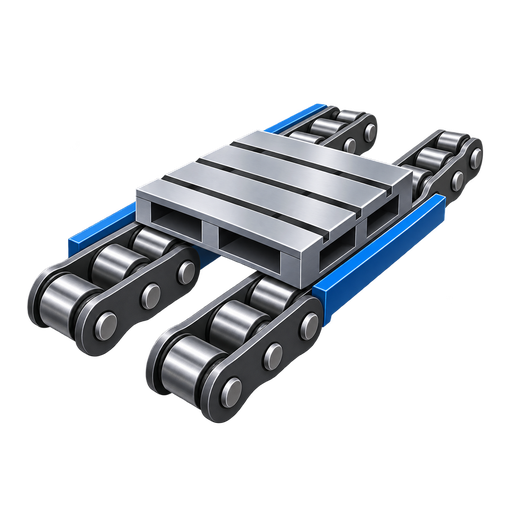
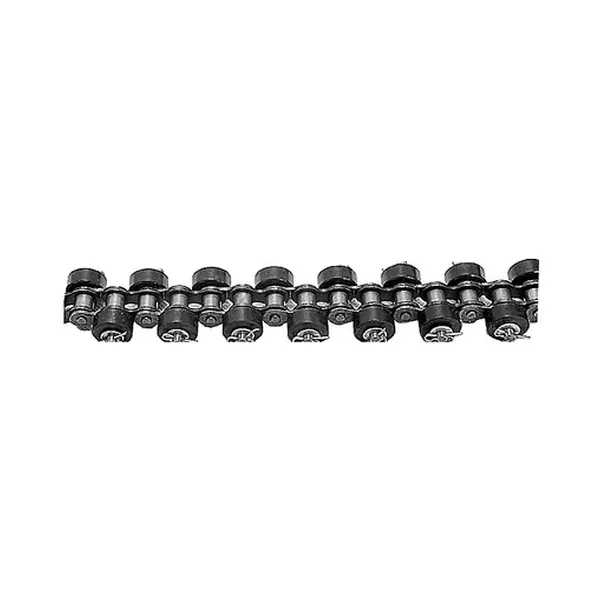
Side Roller Chains place rollers outboard of the chain body so the chain can run or be supported against defined side rails. The side-roller position changes how load enters the chain and how the conveyor tracks, so rail geometry and sprocket clearance are important selection inputs.
Family configuration
The category includes polyacetal side-roller, double-pitch side-roller and stainless side-roller configurations. Choose by exact pitch, side-roller diameter and location, plate geometry, rail contact and environment rather than by overall appearance.
Start with the conveyor function and carrier interface, then compare the model drawing. For replacement work, use measured dimensions from the installed chain and sprocket rather than a visual match.
Machine interfaces to confirm before model selection
Pitch and strand geometry
Measure several pitches, confirm strand spacing and note whether the conveyor uses matched parallel strands. Record the installed sprocket tooth count and bore so engagement can be checked.
Roller and rail contact
Identify which roller or chain surface carries the load, rail width and material, return support and any side guide. Photograph the contact area when the conveyor is an existing machine.
Тасымалдаушының астыңғы жағы
Record the pallet contact surfaces, wear strips, locating features, center of gravity and any lift or transfer mechanism that changes how the carrier is supported.
Duty and environment
State conveyor speed, starts per hour, accumulation time, maximum queue, contamination, temperature, lubrication constraints and maintenance access.
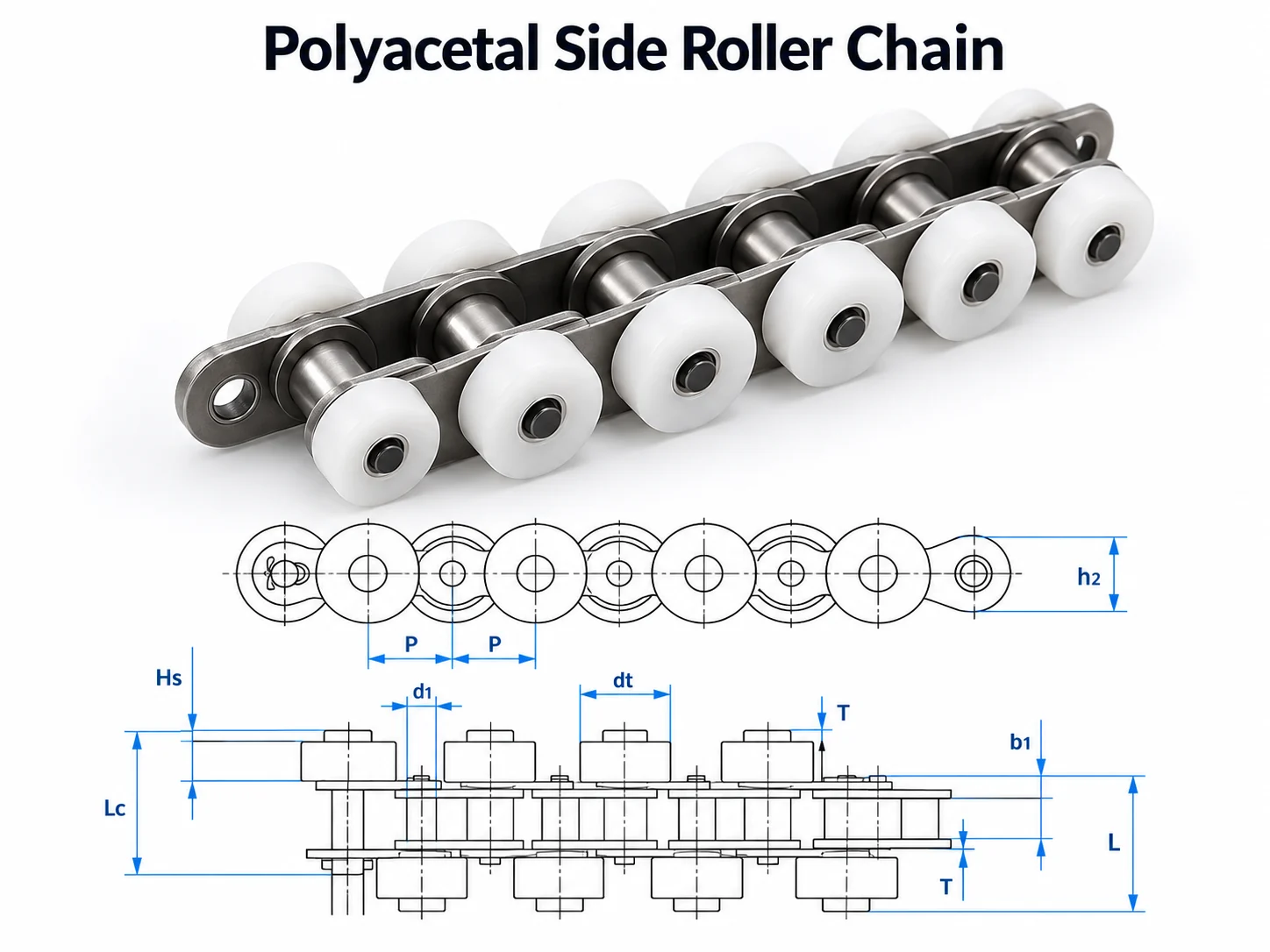
Use the drawing to close the dimensional match
Model selection should move from system requirements to the exact chain geometry. Compare pitch, roller diameters and positions, pin diameter and length, plate height and thickness, and any special attachment or hollow-pin feature shown on the drawing. A match on pitch alone is not enough to approve interchangeability.
When dimensions are missing from an old machine record, measure the installed chain over several joints to reduce single-joint error, then add side and end photographs. If the sprocket is worn or is being replaced at the same time, include its tooth count, bore and hub arrangement in the review.
Applications and operating duty
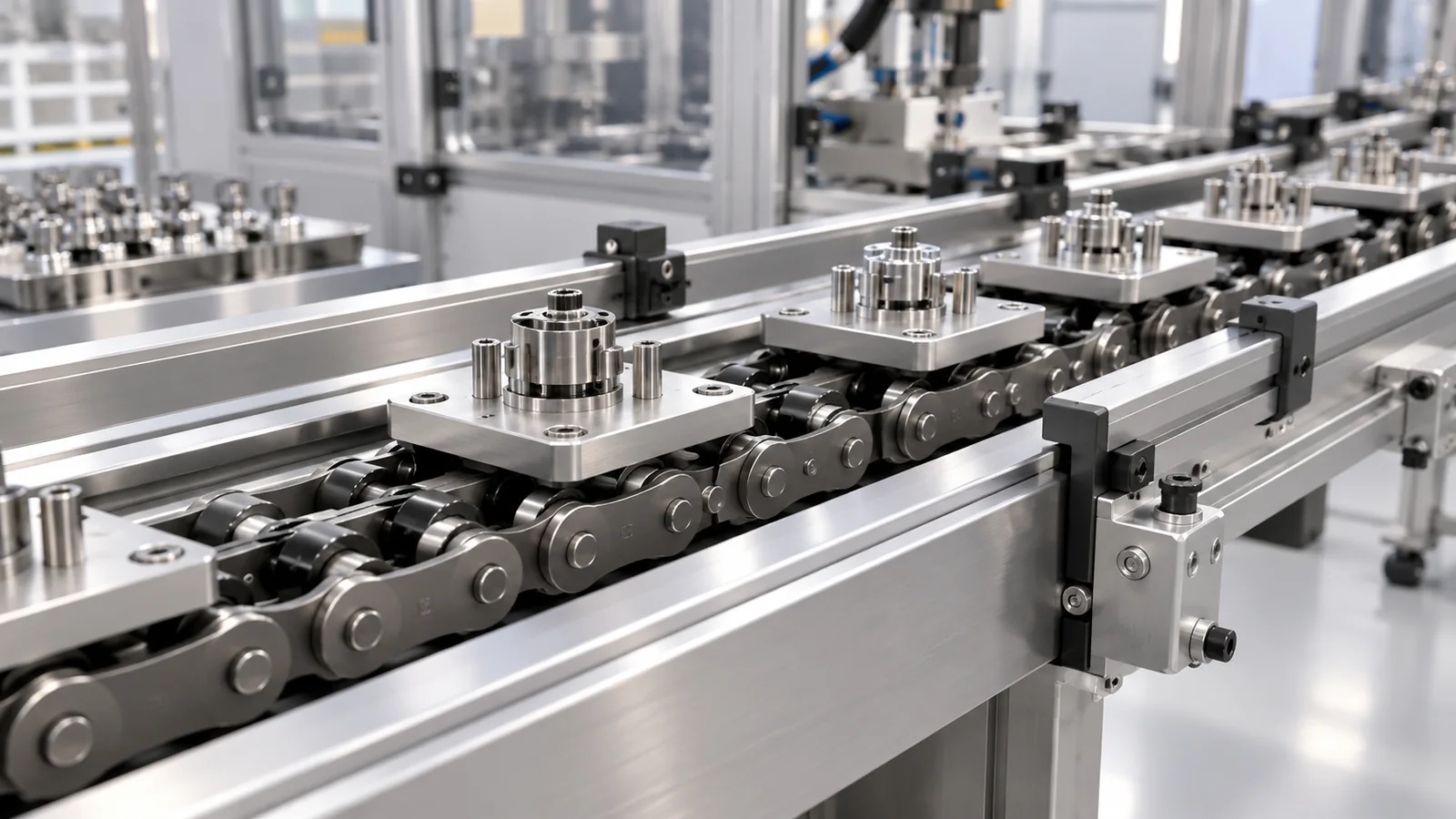
Side Roller Chains may be considered for palletized assembly, inspection, workpiece transfer, accumulation or machine-tending layouts when the chain architecture matches the rail and carrier design. The application name does not by itself confirm a model.
Describe loaded carrier mass, conveyor length, line speed, start/stop frequency and the number of carriers that can occupy the line. For accumulation, state queue length and release sequence. For locating or machining stations, identify the device that supports process forces so those loads are not unintentionally transferred through the conveyor chain.
Selection workflow
| Step | Decision | Information to provide |
|---|---|---|
| 1 | Define the carrier path | Loaded mass, pallet underside, stations, accumulation zones and transfers. |
| 2 | Confirm chain/rail interface | Pitch, roller arrangement, strand spacing, rail section and return support. |
| 3 | Confirm drive interface | Sprocket tooth count, bore, drive position, take-up and shaft alignment. |
| 4 | Check duty and environment | Speed, starts, queue behavior, temperature, contamination and lubrication limits. |
| 5 | Release the model | Exact product drawing, quantity, documentation and delivery requirement. |
Commissioning and maintenance checks
After installation, run the line slowly without load and watch chain entry and exit at the sprockets, rail transitions, take-up travel and carrier tracking. Add representative pallets and confirm roller rotation, stop/release behavior and transfers before raising speed. Uneven tracking, scuffing, chain climbing, impact at transfers or different tension between parallel strands should be corrected before production release.
Maintenance should trend elongation over a defined number of pitches, roller condition, plate wear, rail wear, sprocket tooth condition and take-up position. Record the same measurement points each time so changes can be compared rather than relying on a single visual inspection.
FAQ and RFQ preparation
Can a visually similar chain be substituted?
Not on appearance alone. Compare the complete dimension set and the installed sprocket, rail and carrier interfaces before approving a replacement.
What photographs are useful?
Provide a side view of several pitches, an end view showing roller or hollow-pin position, the sprocket and the rail/contact surface. Add the model marking if it is still readable.
What should a new-system RFQ include?
Send carrier/load data, conveyor length and speed, process sequence, strand spacing, rail concept, drive/take-up layout, quantity and environment.
What should a replacement RFQ include?
Send installed model, measured dimensions, photographs, sprocket data, quantity and any special matched-length, attachment or material requirement.
Review the инженерлік іріктеу жұмысының барысы and application guidance, then use the form below with drawings or marked photographs.
Баға сұрауDocumentation and release package
Before releasing a replacement or new-system order, keep the dimensional match and the commercial request in the same project record. Record the selected model, several-pitch measurement where applicable, roller or pin arrangement, strand spacing, sprocket tooth count and bore, rail/contact geometry and carrier underside. Add the operating inputs that cannot be read from the chain itself: loaded carrier mass, line speed, starts per hour, maximum accumulation, transfers, contamination and lubrication constraints.
For a replacement, photographs should show more than the chain on a bench. Include a side view of several pitches, an end view that shows roller position, the sprocket and shaft arrangement, the rail surface and the carrier interface. If a failure or abnormal wear triggered the replacement, mark the location on the conveyor and record whether the symptom appears under load, during accumulation, at restart or at a transfer. This helps distinguish an identification problem from an alignment, lubrication or station-interface problem.
For procurement, state quantity, required delivery destination, any matched-strand or special-length requirement and the documents that must accompany the order. Product-specific inspection reports, material documents or compliance records should be requested at quotation stage so the available document set can be confirmed before production. Unsupported material grades, coatings, allowable loads or special tolerances remain engineering confirmation items rather than assumptions based on a neighboring model.
Products in Side Roller Chains
-
06B-CDL Stainless Steel Side Roller Chain
Read more -
06C-CDL Stainless Steel Side Roller Chain
Read more -
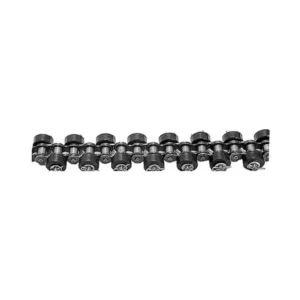
08A-PSR Polyacetal Side Roller Chain
Read more -
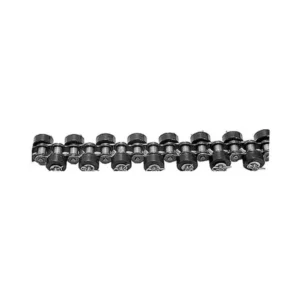
10A-PSR Polyacetal Side Roller Chain
Read more -
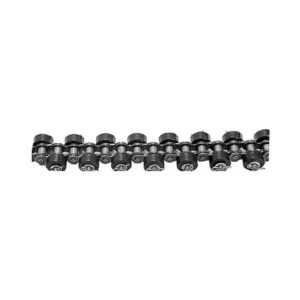
12A-PSR Polyacetal Side Roller Chain
Read more -
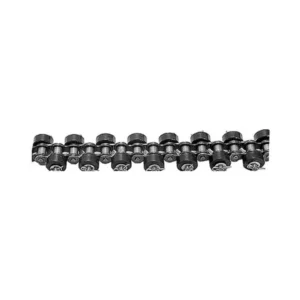
16A-PSR Polyacetal Side Roller Chain
Read more -
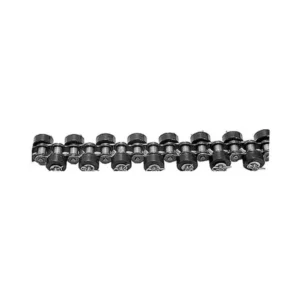
20A-PSR Polyacetal Side Roller Chain
Read more -
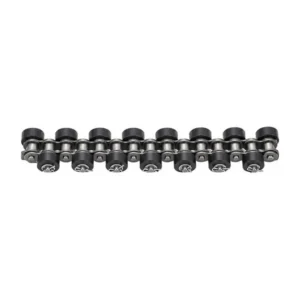
C210A-PSR Double Pitch Polyacetal Side Roller Chain
Read more -
C216AL-PSR Double Pitch Polyacetal Side Roller Chain
Read more