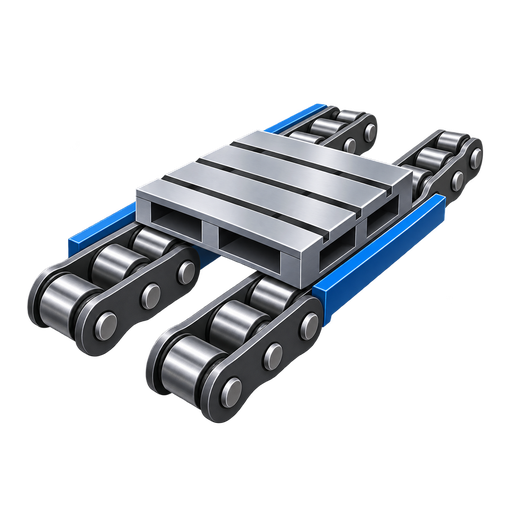
Guide Rails and Wear Strips for Pallet Chain Conveyors
Practical engineering guide: Guide Rails and Wear Strips for Pallet Chain Conveyors. Selection, interfaces, application checks, maintenance and RFQ inputs.
This guide focuses on how rail support, surface finish, alignment and transitions influence rollers and chain tracking. It is written for machine builders, maintenance teams and buyers who need a chain selection that can be checked against drawings and the real conveyor rather than a generic product label.
Guide Rails and Wear Strips for Pallet Chain Conveyors
A pallet conveyor looks simple from a distance, but its reliability depends on several interfaces working at the same time. In a typical project such as a long assembly conveyor with several bolted rail sections, chain pitch, roller contact, rail alignment, sprocket engagement, carrier stiffness, stops and maintenance access all influence the result. A useful engineering review therefore combines model-level data with the operating sequence of the machine.

为什么这个问题很重要
How rail support, surface finish, alignment and transitions influence rollers and chain tracking affects more than catalogue selection. It changes how the workpiece carrier enters a station, how loads pass into guide rails, how the chain approaches the drive and how the system behaves during stopping or accumulation. If one interface is ignored, the symptom may appear somewhere else: a roller can wear because a rail joint is high, a chain can pull sideways because a pallet stop is offset, or a new chain can run badly because the old sprocket is worn.
The practical objective is not to eliminate every variation in the machine. It is to identify the variables that must be controlled, define which dimensions are fixed by the chain source, and leave unsupported items for explicit RFQ confirmation. This is also why creating a step at a rail joint that repeatedly impacts a roller is a risky shortcut. It replaces measurable machine data with an assumption and can make a correct-looking part fail at installation.
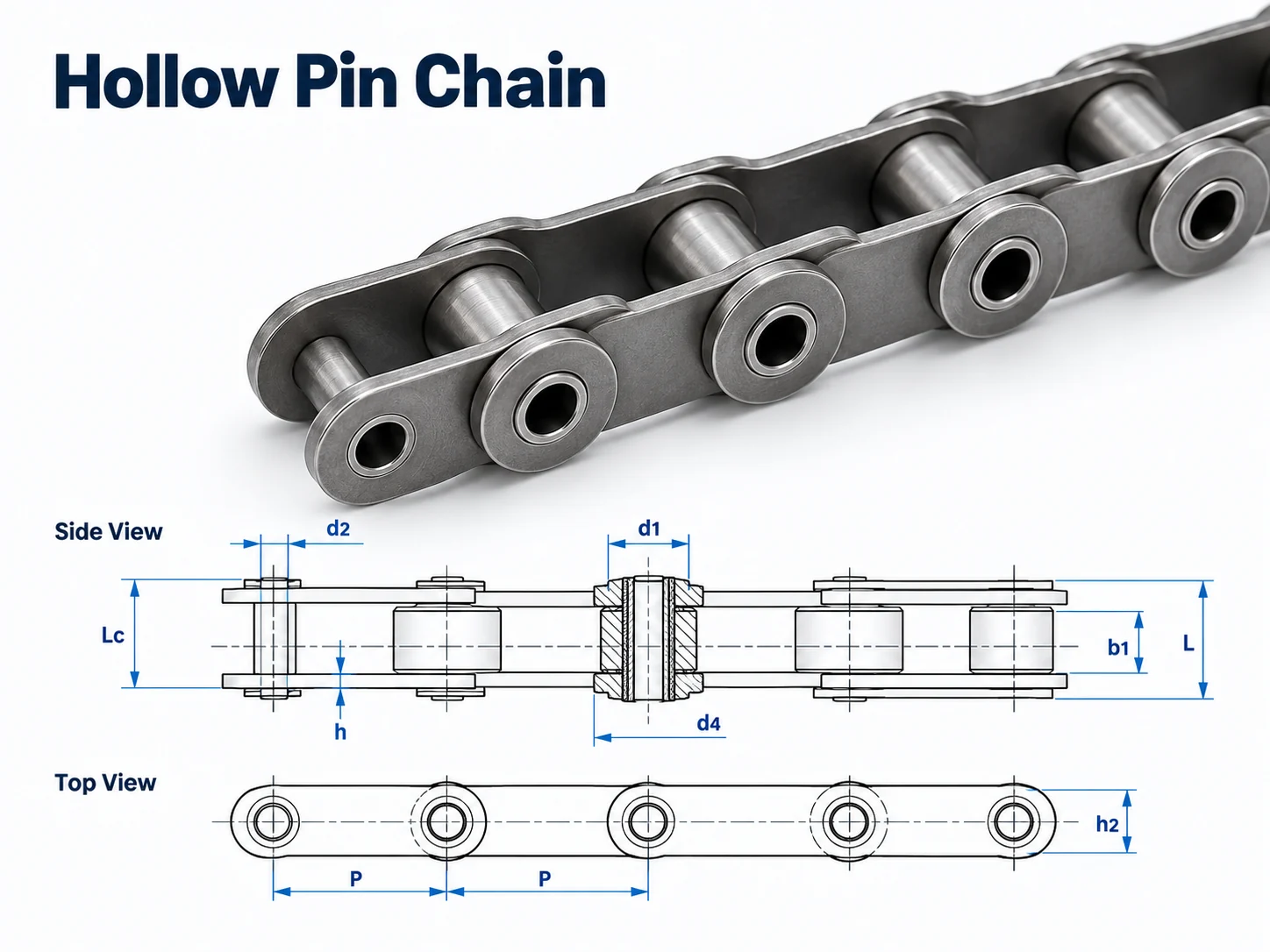
首先要进行四项检查。
Rail Material
Record the relevant diameter, offset, contact surface, clearance and visible wear so the running interface can be checked.
Straightness
说明适用于输送机该部分的测量条件、安装接口和验收检查。
Joint Transitions
说明适用于输送机该部分的测量条件、安装接口和验收检查。
Lubrication Compatibility
State the real operating environment and maintenance constraints so material and lubrication choices are reviewed for the complete conveyor.
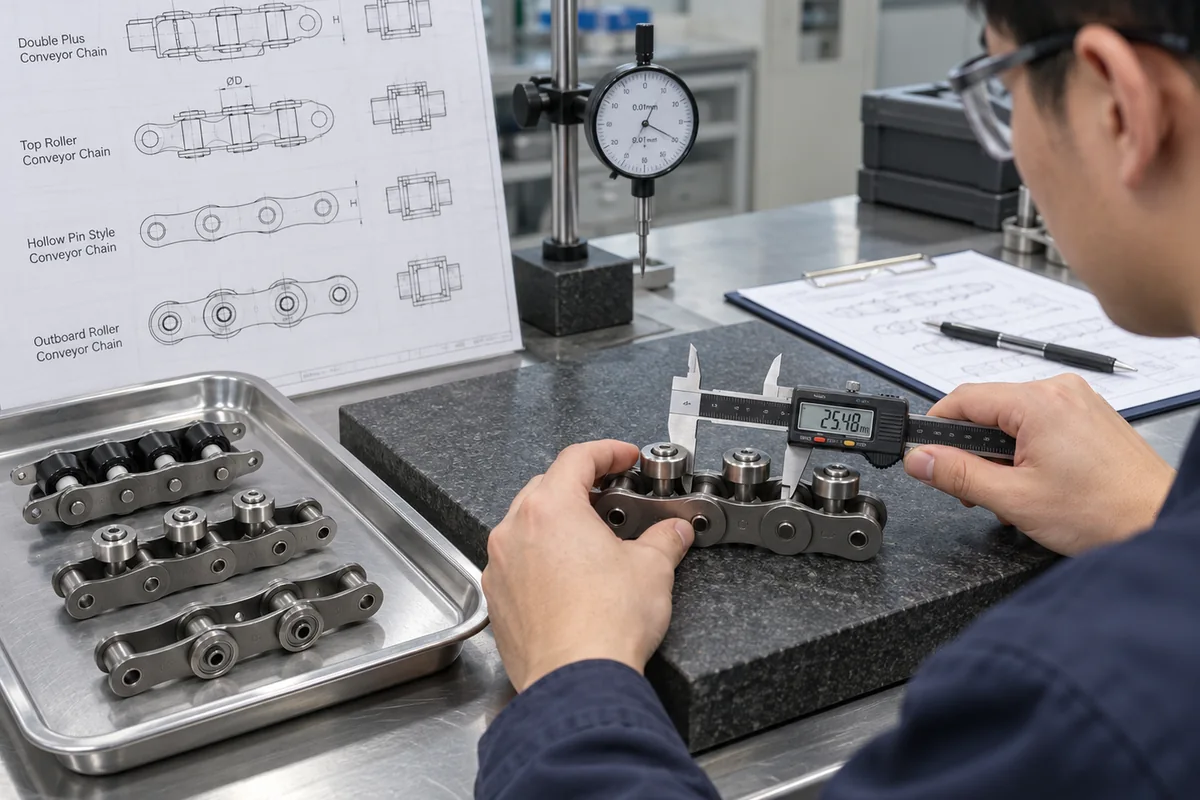
首先确定链条的精确几何形状。
如有型号,请使用准确的型号规格和相应的图纸。比较节距、滚轮直径、内宽、销轴直径和长度、链板高度和厚度,以及与输送机连接的任何侧滚轮、大滚轮或空心销轴的尺寸。如果型号未知,则需系统地测量已安装的链条。测量多个销轴之间的节距比读取单个磨损间隙更可靠,并且照片应显示侧面轮廓、滚轮排列、链轮和导轨接触情况。
请勿将抗拉强度作为托盘有效载荷的依据。产品目录中的抗拉强度数据是材料/部件的测试性能。输送机的工作条件还涉及线路长度、链条股数、托架数量、加速度、冲击、摩擦、润滑、链轮尺寸、磨损状态以及所需的安全系数。只有在充分了解这些条件之后,才能对链条进行系统验证。
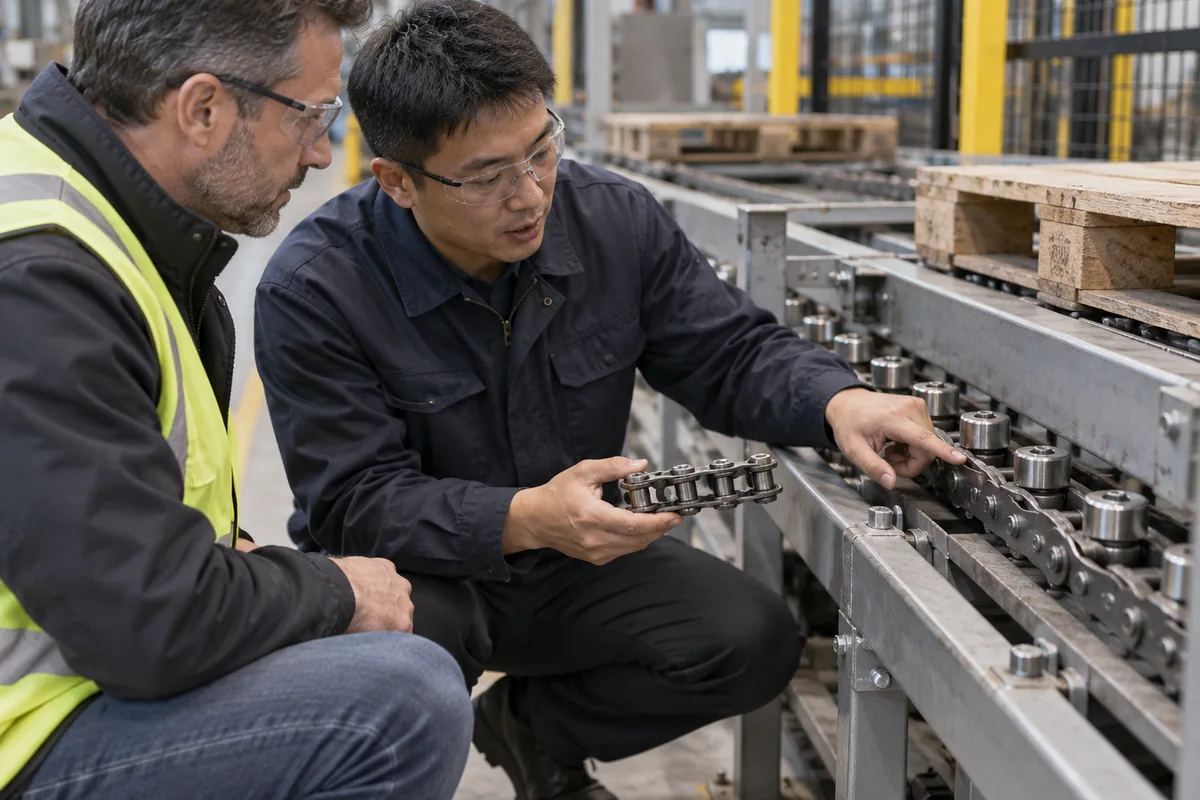
选择工作流程
- Rail Material: 将所需条件与确切的链条图或系统布局进行比较,并记录任何待询价确认的问题。
- Straightness: 将所需条件与确切的链条图或系统布局进行比较,并记录任何待询价确认的问题。
- Joint Transitions: 将所需条件与确切的链条图或系统布局进行比较,并记录任何待询价确认的问题。
- Lubrication Compatibility: 将所需条件与确切的链条图或系统布局进行比较,并记录任何待询价确认的问题。
- 承运人和职责: 记录载货机质量、载货机数量、线路速度、每小时启动次数、累积模式以及任何倾斜或垂直过渡。
- 驾车并返回: 确认链轮数据、轴对准情况、张紧范围、回位支撑和润滑通道。
- 发布条件: 对于技术数据中未明确说明的任何字段(例如特殊材料等级、涂层、允许的系统负荷或环境等级),应将其作为询价确认项目列出,而不是进行估算。
系统集成
确定链条后,检查输送机如何将负载传递到机器的其他部分。导轨或耐磨轨道应支撑预定的滚筒表面,并在接头处保持连续性。平行链条应具有规定的中心距和同步驱动时序。挡块应接触设计的托盘面,而不是链条侧板。横向转移和提升需要足够的支撑,以防止托架掉入缝隙或落在销/板边缘上。
对于累积式系统,应将输送和停止分开。链条可以在托架被固定时继续运行,但仍需检查停止力、队列长度、重启顺序和局部摩擦力。对于用于定位工件进行加工的系统,当所需的重复精度比普通传送带输送所能提供的精度更高时,应使用专用定位装置。
调试和维护
首先以低速试运行新的或维修后的输送机。让输送机完整运行几个链条回路,并观察其驱动、回程、轨道过渡、停止和转移情况。注意聆听每链条旋转一周或每链轮旋转一周重复一次的声音,因为这些模式有助于定位过紧的接头、滚轮损坏、局部轨道台阶或链轮问题。对于刚性工件托盘,注意平行链条之间的倾斜情况;即使是微小的时序差异也可能导致托盘一侧受力过大。
维护应着眼于趋势而非等到故障发生。应使用认可的方法记录伸长率或长度检查结果,检查滚子是否自由旋转以及是否存在异常平面,检查是否存在表明不对中的抛光侧接触痕迹,检查链轮齿并确认张紧位置。润滑周期应根据运行环境和链条制造商的指导进行调整;如果润滑剂会吸附磨料污染物或进入工艺区域,那么增加润滑剂用量并非总是更好。
询价清单
如需更换链条,请提供型号代码(如清晰可辨)、测量节距、滚轮排列方式、链条宽度、链板高度、销轴尺寸、侧面轮廓照片以及显示链轮/导轨接触情况的照片。如需安装新系统,请提供输送机长度、托架尺寸和负载质量、链条股数、链条间距、速度、启动/停止次数、缓冲长度、环境条件和目的地国家/地区。这些信息有助于从完整的输送机负荷计算中区分出合适的链条。
Use contact marks to tune the guide rail
The rail should support the intended roller or chain surface continuously through joints, transfers and changes in elevation. Polished marks, edge wear or localized scuffing show where the real load path differs from the drawing.
Check rail straightness, joint steps, parallelism between strands and the transition into sprockets. Material and lubrication decisions should also consider contamination and maintenance access. Correct rail geometry before using tension or extra lubrication to mask a tracking problem.
测量接口
当替换件必须适配现有机器时,请使用多个节距尺寸、端视图几何形状和链轮/导轨细节。
描述职责
包括载重载具的质量、速度、启动次数、累积或索引行为以及运行环境。
测试最坏情况
与代表性承运商合作,满足最苛刻的排队、停车、转运或重新出发条件,而不仅仅是空载旅行。
保持未决事项明确
如果材料、涂层、特殊公差、文件要求或允许的系统负载未明确说明,请在询价中确认。
常见问题解答
我能否仅凭音调来选择替换球员?
For guide rails and wear strips for pallet chain conveyors, pitch is only the first filter. Confirm roller geometry, inner width, pins, plates and any side-roller or hollow-pin features against the installed conveyor before treating two chains as interchangeable.
更高的抗拉强度值是否意味着我可以在托盘上承载更大的载荷?
For guide rails and wear strips for pallet chain conveyors, do not convert tensile strength directly into pallet payload. Service load depends on strand count, friction, acceleration, stop impact, sprockets, rails and the safety margin used for the machine.
一张具有代表性的家庭照片能否证明是哪一款?
不。一张具有代表性的家庭照片可以帮助解释结构,但模型标识和尺寸必须来自特定模型的技术规范、图纸或已确认的制造数据。
哪些信息可以加快报价速度?
For an RFQ related to guide rails and wear strips for pallet chain conveyors, send the model code or dimensional sketch, clear photographs, conveyor layout, loaded carrier information, quantity and delivery country so the review starts from reproducible machine data.
Key engineering variables for Guide Rails and Wear Strips for Pallet Chain Conveyors
决策应基于可测量的机器输入和精确的链条图纸,而非通用的系列标签。用一行文字记录运行情况:传送带输送的物品、运行速度、停止位置以及触发审查的条件。记录其他工程师可以复现的尺寸和观察结果。
| 输入 | 要记录什么 | 为什么这很重要 |
|---|---|---|
| 承运人/货物 | 负载质量、重心、底部接触面和载体数量 | 支持、摩擦和停止行为 |
| 运动 | 速度、启动、停止、累积和索引 | 动态需求和流程时间 |
| 链路径 | 节距、滚轮、钢绞线间距和钢轨 | 机械配合和跟踪 |
| 驾驶 | 链轮齿、对齐、张紧和驱动位置 | 参与度和紧张度分布 |
| 环境 | 温度、灰尘、湿度、清洁和润滑限制 | 材料和维护选择 |
相关产品和选择资源
What to include with an enquiry about Guide Rails and Wear Strips for Pallet Chain Conveyors
明确已安装或拟安装的链条系列、数量、应用、承载/负载、关键尺寸以及新部件需要解决的运行工况。如果现有规范不确定,请附上照片或图纸,并保持材料、文档或交付要求清晰可见。
Turn symptoms into measured maintenance data
Maintenance decisions become more reliable when the same points are measured at each inspection. Mark a repeatable chain section, measure elongation over several pitches, record take-up position and inspect the corresponding sprocket teeth and rail contact. Note whether wear is even on both strands, whether rollers rotate freely and whether the carrier tracks centrally through transfers. For noise or vibration complaints, record the operating state when the symptom occurs: empty running, loaded transfer, accumulation, restart or a specific station. That separates chain wear from alignment, transfer impact, loose guarding or a damaged carrier. Lubrication changes should be tied to the chain construction and environment rather than used as a universal response to noise.
Measure
Several-pitch elongation, roller rotation, take-up position and strand-to-strand difference.
Inspect
Sprocket tooth profile, rail wear, transfer impact points, fasteners and carrier underside contact.
Record
Operating state, load, queue condition, temperature/contamination and the exact location of the symptom.
Decide
Correct alignment or interface faults before replacing chain solely because a symptom is present.
Inspect rail continuity, support and contact before commissioning
Guide rails and wear strips should present a continuous, correctly located running surface to the roller or chain element they are intended to support. Pay particular attention to joints, fasteners, transfer transitions and local height changes because a small step can create repeated impact at every passing pitch. The rail must also stay laterally stable under the actual carrier load and stop sequence.
During commissioning, mark several rail joints and observe the chain at low speed before adding full carrier load. Look for roller lift, side rubbing, sudden sound changes or a visible change in chain path. For replacement work, photographs of the rail cross-section and worn contact surface help separate normal running marks from a geometry or alignment issue.
Measure the interfaces that control fit and tracking
For Guide Rails and Wear Strips for Pallet Chain Conveyors, start with a dimensioned record of the installed conveyor. Measure several pitches rather than one joint, then add roller or pin geometry, plate dimensions, strand centers and the rail/contact section. At the drive, record sprocket tooth count, bore or shaft arrangement and visible tooth wear. At stations, identify stop faces, locators, transfer gaps and the carrier surfaces that actually touch the conveyor.
Repeat the review with a representative loaded pallet at safe low speed. Watch whether the carrier stays square, whether both strands share the load and whether any symptom begins at the same fixed location. A change tied to one rail joint, stop or sprocket should be corrected at that interface before chain tension or a new chain is used as the remedy. Keep photographs of the measurement reference points with the RFQ so an engineer can reproduce the comparison against the proposed drawing.
Chain geometry
Several-pitch length plus roller, pin, plate and attachment dimensions.
Carrier geometry
Loaded mass, underside supports, datums, center of gravity and stop faces.
Drive geometry
Sprocket, shaft, center distance and available take-up travel.
Fixed locations
Rail joints, transfers, stops and points with recurring wear or impact.
Read the wear pattern along the rail
Walk the rail from drive to return and mark joints, transfers and locations with heavy polish, grooves or edge contact. Compare the marks with roller position and carrier path. A short bright band at a joint often tells more about local alignment than a general statement that the chain is noisy or wearing quickly.
Check rail straightness, height and parallelism between strands. Use a straightedge across joints and verify that transfer sections maintain support under the intended roller or carrier surface. If a wear strip is replaceable, inspect its retaining method and whether a lifted edge can catch a roller.
During commissioning, observe a loaded carrier through the same marked locations. Correct the rail geometry before increasing tension or lubrication. Include the rail cross-section and end photographs with a replacement RFQ, because chain dimensions and rail geometry must be reviewed together.