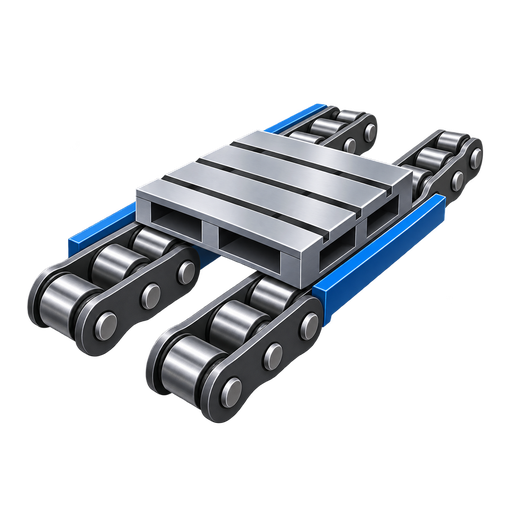
Inspection and Test Conveyor Design
Practical engineering guide: Inspection and Test Conveyor Design. Selection, interfaces, application checks, maintenance and RFQ inputs.
This guide focuses on how a carrier can be transported by chain but precisely located by dedicated station hardware for inspection and testing. It is written for machine builders, maintenance teams and buyers who need a chain selection that can be checked against drawings and the real conveyor rather than a generic product label.
Inspection and Test Conveyor Design
Many conveyor problems begin when a correct catalogue component is installed into an interface that was never checked in detail. In a typical project such as a leak-test or vision-inspection station, chain pitch, roller contact, rail alignment, sprocket engagement, carrier stiffness, stops and maintenance access all influence the result. A useful engineering review therefore combines model-level data with the operating sequence of the machine.
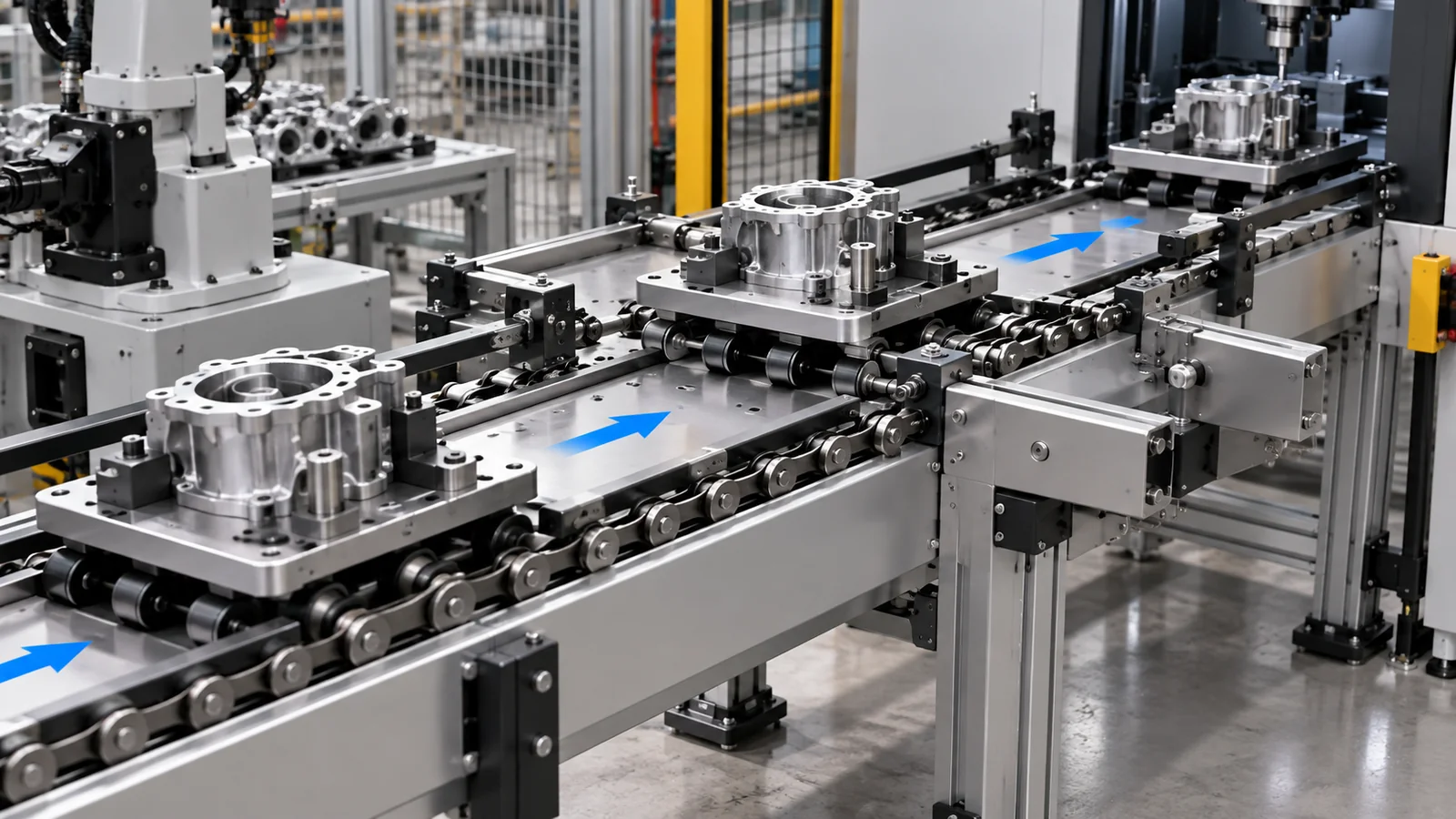
Why this issue matters
How a carrier can be transported by chain but precisely located by dedicated station hardware for inspection and testing affects more than catalogue selection. It changes how the workpiece carrier enters a station, how loads pass into guide rails, how the chain approaches the drive and how the system behaves during stopping or accumulation. If one interface is ignored, the symptom may appear somewhere else: a roller can wear because a rail joint is high, a chain can pull sideways because a pallet stop is offset, or a new chain can run badly because the old sprocket is worn.
The practical objective is not to eliminate every variation in the machine. It is to identify the variables that must be controlled, define which dimensions are fixed by the chain source, and leave unsupported items for explicit RFQ confirmation. This is also why assuming the moving chain can serve as the final precision datum is a risky shortcut. It replaces measurable evidence with an assumption and can make a correct-looking part fail at installation.
Four checks to define first
Datum Strategy
Define this item in measurable terms before the chain or conveyor is released. Record the drawing dimension, operating condition or inspection method that will be used to verify it.
Test Cycle Time
Define this item in measurable terms before the chain or conveyor is released. Record the drawing dimension, operating condition or inspection method that will be used to verify it.
Re-Test Routing
Define this item in measurable terms before the chain or conveyor is released. Record the drawing dimension, operating condition or inspection method that will be used to verify it.
Sensor Clearance
Define this item in measurable terms before the chain or conveyor is released. Record the drawing dimension, operating condition or inspection method that will be used to verify it.
Start with the exact chain geometry
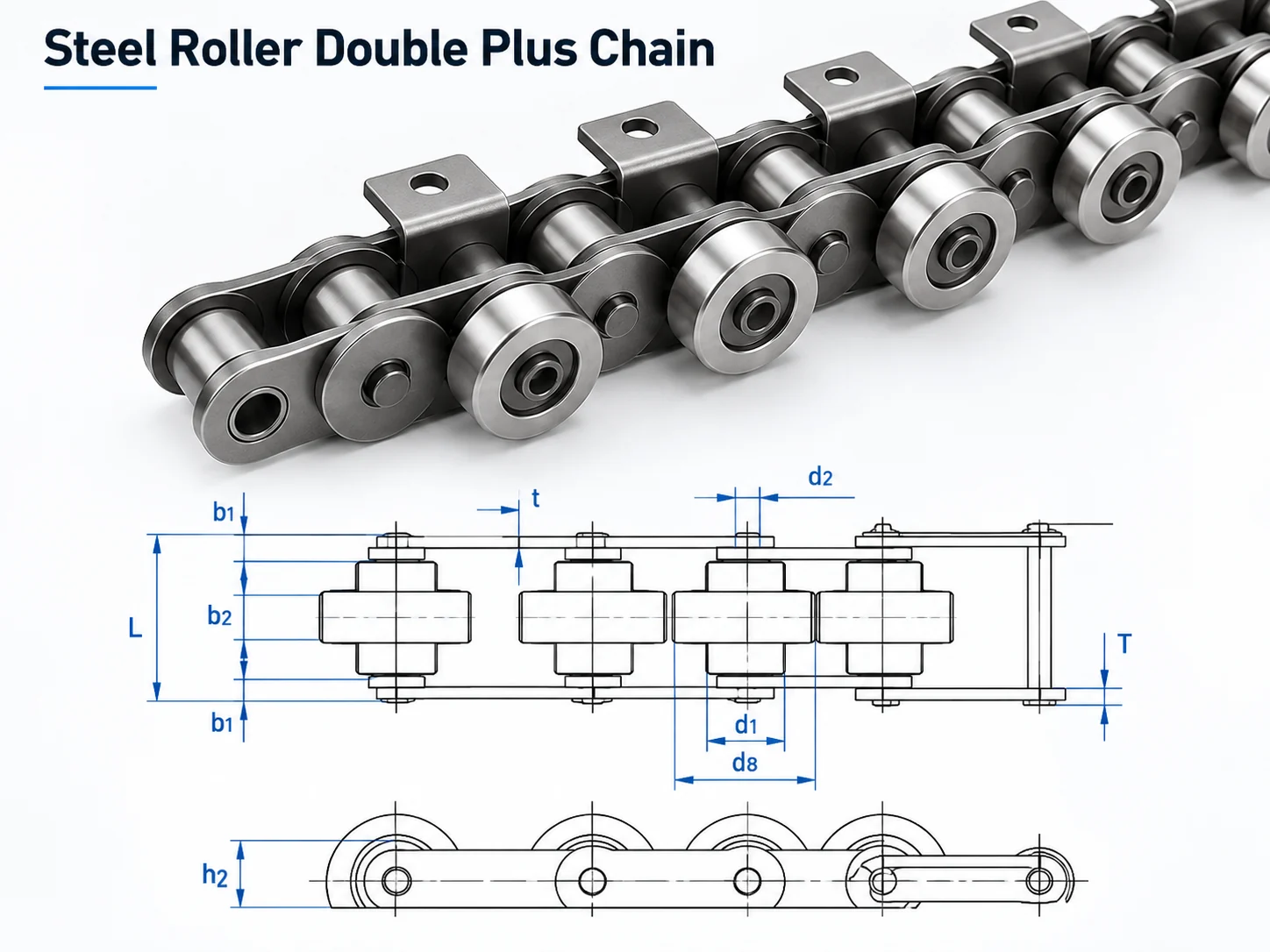
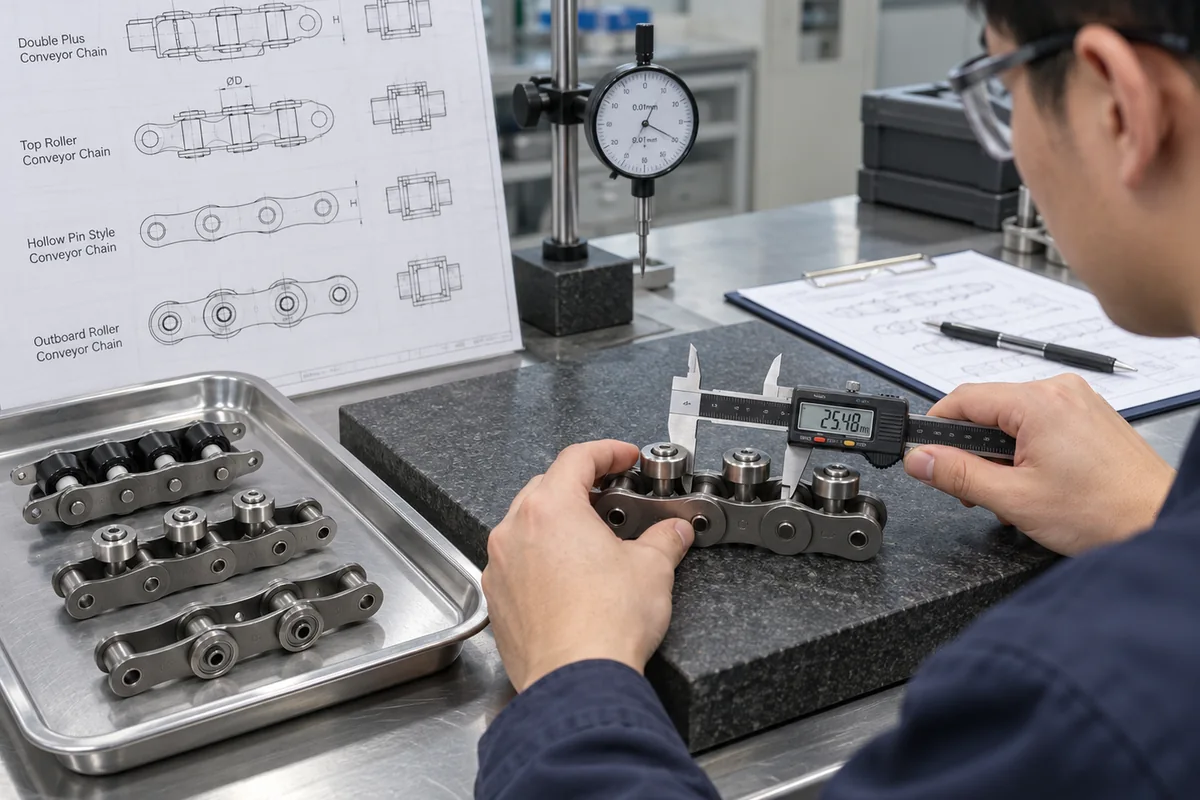
When a model number is available, use the exact model specification and the matching drawing. Compare pitch, roller diameters, inner width, pin diameter and length, plate height and thickness, and any side-roller, large-roller or hollow-pin dimensions that interface with the conveyor. When the code is unknown, measure the installed chain systematically. Measuring pitch across several pins is more reliable than reading a single worn gap, and photographs should show the side profile, roller arrangement, sprocket and rail contact.
Do not use tensile strength as the pallet payload. Catalogue tensile figures are material/component test properties. Conveyor working conditions also involve line length, the number of chain strands, carrier count, acceleration, shock, friction, lubrication, sprocket size, wear state and the required safety factor. The chain can only be released for a system after those conditions are understood.
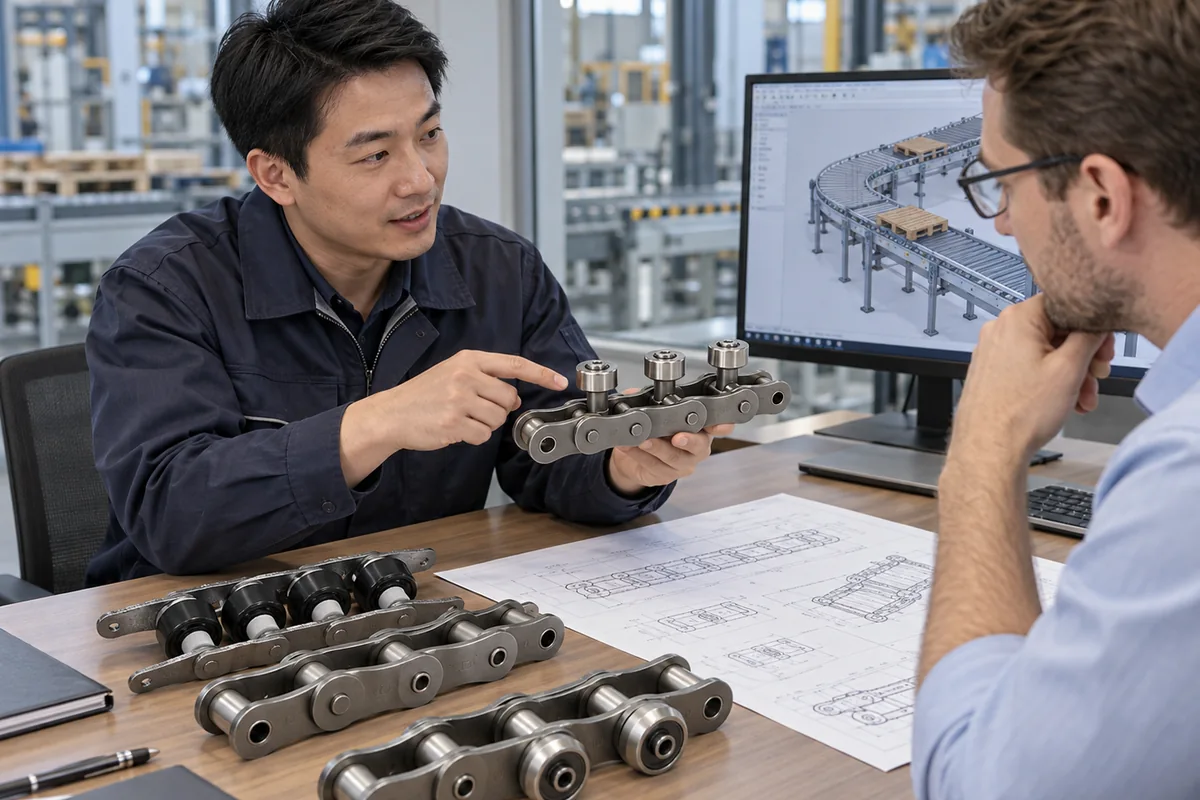
Selection workflow
- Datum Strategy: compare the required condition with the exact chain drawing or system layout and record any open question for RFQ confirmation.
- Test Cycle Time: compare the required condition with the exact chain drawing or system layout and record any open question for RFQ confirmation.
- Re-Test Routing: compare the required condition with the exact chain drawing or system layout and record any open question for RFQ confirmation.
- Sensor Clearance: compare the required condition with the exact chain drawing or system layout and record any open question for RFQ confirmation.
- Carrier and duty: record loaded carrier mass, number of carriers, line speed, starts per hour, accumulation pattern and any incline or vertical transition.
- Drive and return: confirm sprocket data, shaft alignment, take-up range, return support and lubrication access.
- Release condition: list any field that the technical data does not state—such as a special material grade, coating, allowable system load or environmental rating—as an RFQ confirmation item instead of estimating it.
System integration
Once the chain is identified, check how the conveyor transfers load into the rest of the machine. The guide or wear rail should support the intended roller surface and remain continuous through joints. Parallel strands should have the specified center distance and synchronized drive timing. Stops should contact a designed pallet face, not the chain side plate. Cross transfers and lifts need enough support so the carrier does not drop into a gap or land on a pin/plate edge.
For systems that accumulate, separate transport from stopping. The chain may continue moving while the carrier is held, but the stop force, queue length, restart sequence and local friction still need to be checked. For systems that position a workpiece for processing, use dedicated locating features when the required repeatability is tighter than normal conveyor transport can provide.
Commissioning and maintenance
Commission a new or repaired conveyor at low speed first. Jog several complete chain circuits and observe the drive, return, rail transitions, stops and transfers. Listen for sounds that repeat once per chain revolution or once per sprocket rotation because those patterns help isolate a tight joint, roller damage, local rail step or sprocket issue. With rigid workpiece pallets, watch for skewing across parallel strands; even small timing differences can load one side of the carrier.
Maintenance should track trends instead of waiting for a failure. Record elongation or length checks using the approved method, inspect rollers for free rotation and abnormal flats, look for polished side-contact marks that suggest misalignment, inspect sprocket teeth and verify take-up position. Lubrication intervals should reflect the operating environment and the chain manufacturer’s guidance; more lubricant is not automatically better if it attracts abrasive contamination or enters a process area.
RFQ checklist
For a replacement request, send the model code if legible, measured pitch, roller arrangement, chain width, plate height, pin dimensions, a photograph of the side profile and a photograph showing sprocket/rail contact. For a new system, add conveyor length, carrier size and loaded mass, number of strands, strand spacing, speed, starts/stops, buffer length, environmental conditions and destination country. These details make it possible to separate a chain match from a full conveyor-duty calculation.
Frequently asked questions
Can I select a replacement from pitch alone?
For inspection and test conveyor design, pitch is only the first filter. Confirm roller geometry, inner width, pins, plates and any side-roller or hollow-pin features against the installed conveyor before treating two chains as interchangeable.
Does a higher tensile value mean I can carry that load on the pallet?
For inspection and test conveyor design, do not convert tensile strength directly into pallet payload. Service load depends on strand count, friction, acceleration, stop impact, sprockets, rails and the safety margin used for the machine.
Can a representative family photo prove the exact model?
No. A representative family image can help explain construction, but model identity and dimensions must come from the model-specific technical specification, drawing or confirmed manufacturing data.
What information speeds up a quotation?
For an RFQ related to inspection and test conveyor design, send the model code or dimensional sketch, clear photographs, conveyor layout, loaded carrier information, quantity and delivery country so the review starts from reproducible machine data.
Engineering review points specific to Inspection and Test Conveyor Design
The decision should be tied to measurable machine inputs and the exact chain drawing rather than a generic family label. Record the operating case in one line: what the conveyor carries, how fast it moves, where it stops and what condition triggered the review. Capture dimensions and observations another engineer can reproduce.
| Вход | Что записывать | Почему это важно |
|---|---|---|
| Перевозчик/груз | Loaded mass, center of gravity, underside contact and carrier count | Support, friction and stop behavior |
| Движение | Speed, starts, stops, accumulation and indexing | Dynamic demand and process timing |
| Chain path | Pitch, rollers, strand spacing and rails | Mechanical fit and tracking |
| Водить машину | Sprocket teeth, alignment, take-up and drive position | Engagement and tension distribution |
| Среда | Temperature, dust, moisture, cleaning and lubrication limits | Material and maintenance choices |
Where to continue the review
Используйте pallet conveyor chain catalogue to compare families and the Процесс отбора инженерных решений when machine data is incomplete.
RFQ data for Inspection and Test Conveyor Design
Identify the installed or proposed chain family, quantity, application, carrier/load, key dimensions and the operating condition the new part must solve. Attach photographs or drawings when the existing code is uncertain and keep open material, documentation or delivery requirements visible.
Connect the chain decision to the production station
In an automated cell the chain is only one part of the positioning system. Define where the carrier is allowed to float, where it must be guided and where a locator or lift removes process force from the conveyor. Record station spacing, takt time, carrier mass, queue length and the transfer sequence into and out of the station. For robot or inspection cells, check guard openings, sensor locations and the path of cables, clamps or fixtures under the pallet. A chain that runs correctly on a straight test bed can still create problems if the production line introduces side loading, an abrupt rail step or a stop that catches the carrier above the intended contact point. Commission with real pallets and representative stop sequences before increasing speed.
Process
Takt time, station sequence, queue length and whether the carrier passes, stops, locates, lifts or transfers.
Carrier
Loaded mass, footprint, underside geometry, datum features and center of gravity.
Interface
Rail height, strand centers, transfer modules, stops, locators, sensors and guarding clearance.
Trial
No-load tracking first, then representative pallets and worst-case stop/restart sequences.
Use a field check before making the final decision
Start at the physical interface that can be observed on the machine. Confirm the chain path through the drive and return sprockets, then follow the rail through transfers and stations. Look for contact marks that show where the carrier or roller is actually loading the system. Compare left and right strands when the conveyor uses a pair; differences in tracking, wear or take-up position often reveal an alignment or loading issue that a catalogue comparison cannot show.
When measuring pitch, use several consecutive joints rather than a single pitch. Photograph the measuring setup so the value can be reviewed later. For rollers, record diameter and axial position as well as visible damage. For hollow-pin or attachment chains, photograph the cross rod or fixture and show how its load reaches the carrier or machine. If a stop or locator is involved, identify whether it restrains the pallet independently or transfers force through the chain.
Decision record for Inspection and Test Conveyor Design
Before releasing a purchase or design change, write down what is confirmed and what is still open. Confirmed items should include the measured chain geometry and the installed interfaces that control fit. Open items may include material grade, coating, attachment load, documentation, matched-strand requirement or a custom tolerance. Keeping these separate prevents an assumption from becoming a purchasing specification.
For replacement work, attach the old part number, several-pitch measurement, chain side/end photographs, sprocket tooth count and bore, rail section and quantity. For new equipment, add carrier mass and underside drawing, strand spacing, conveyor length and speed, station sequence, maximum accumulation and the intended drive/take-up layout. This package gives engineering enough information to compare a model without asking the buyer to reconstruct the machine after the quotation has started.
Protect measurement quality from conveyor-induced movement
Inspection and test stations often need the carrier to be more stable than it is during normal conveying. Define whether the pallet remains on the conveyor, is lifted from the chain, or is located against dedicated datums during measurement. If the test applies force or requires tight repeatability, separate that station requirement from the chain’s transport function.
Document sensor or probe access, station dwell time, stop sequence, carrier mass and the direction of any applied test force. During commissioning, verify that the carrier settles consistently and that restarting does not create impact at the next station. If abnormal movement appears, inspect the locator, stop, rail and pallet interfaces before changing the chain specification.
From engineering review to RFQ
Use the product family pages to narrow the chain architecture, then move to a model page only when the required geometry is known. A useful RFQ states the machine function, chain model or measured pitch, quantity, carrier/load data, sprocket and rail information, environment and any inspection or material-document requirement. If the conveyor is already in service, photographs of the actual chain and interfaces are usually more valuable than a generic description of the application.
For complex layouts, include a marked conveyor sketch showing drive position, take-up, transfer points, accumulation zones and the station where the issue occurs. This keeps the quotation tied to a real mechanical condition and makes later technical review easier for both purchasing and maintenance teams.