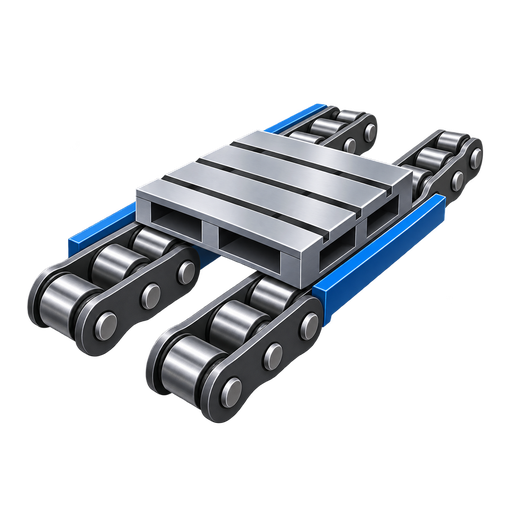
Designing an Accumulation Conveyor with Double Plus Chain
Practical engineering guide: Designing an Accumulation Conveyor with Double Plus Chain. Selection, interfaces, application checks, maintenance and RFQ inputs.
This guide focuses on how to stop workpiece carriers while the base chain continues and how to manage stop, rail and pallet contact forces. It is written for machine builders, maintenance teams and buyers who need a chain selection that can be checked against drawings and the real conveyor rather than a generic product label.
Designing an Accumulation Conveyor with Double Plus Chain
A pallet conveyor looks simple from a distance, but its reliability depends on several interfaces working at the same time. In a typical project such as a buffer between upstream assembly and downstream testing, chain pitch, roller contact, rail alignment, sprocket engagement, carrier stiffness, stops and maintenance access all influence the result. A useful engineering review therefore combines model-level data with the operating sequence of the machine.
Why this issue matters
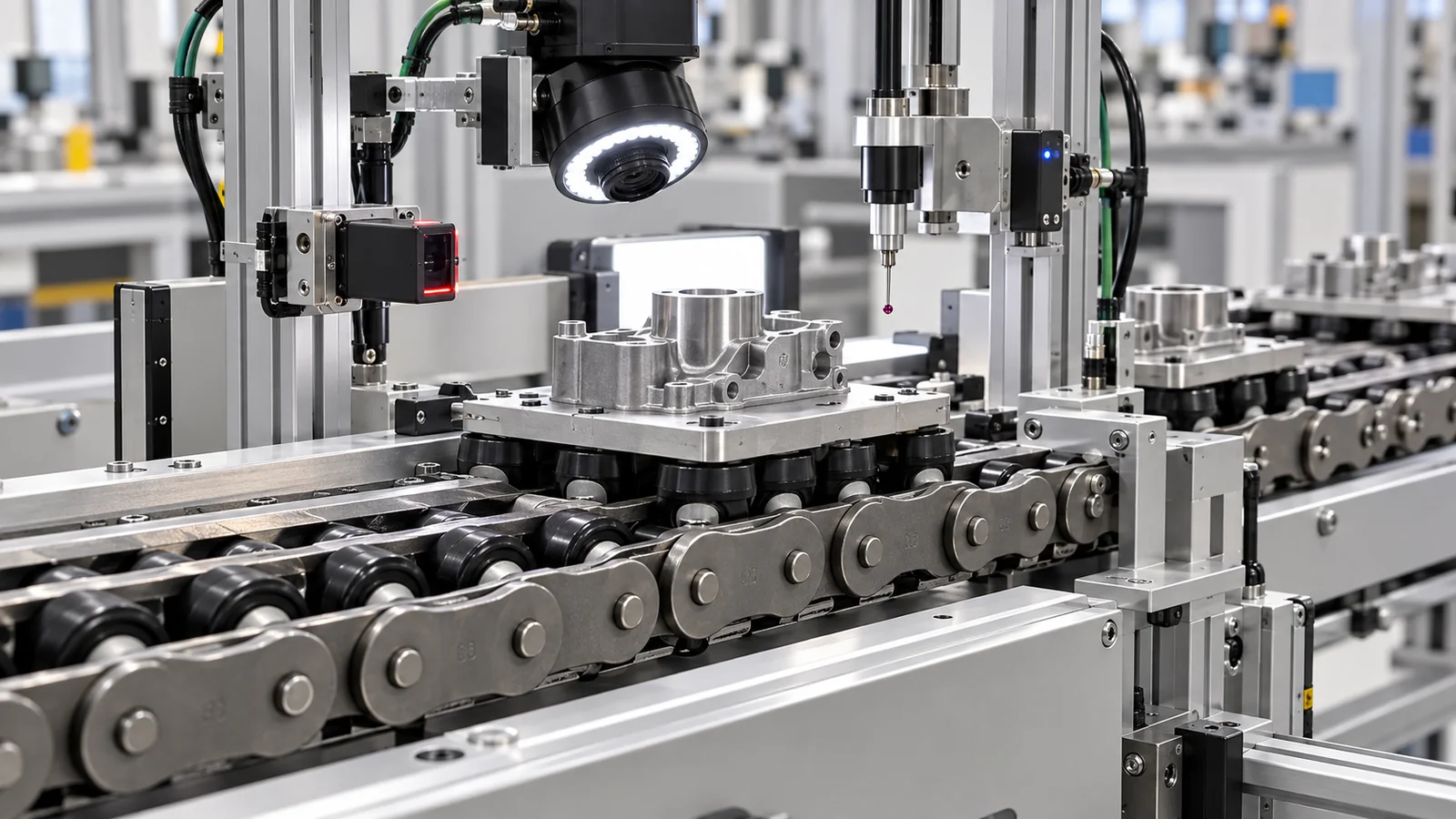
How to stop workpiece carriers while the base chain continues and how to manage stop, rail and pallet contact forces affects more than catalogue selection. It changes how the workpiece carrier enters a station, how loads pass into guide rails, how the chain approaches the drive and how the system behaves during stopping or accumulation. If one interface is ignored, the symptom may appear somewhere else: a roller can wear because a rail joint is high, a chain can pull sideways because a pallet stop is offset, or a new chain can run badly because the old sprocket is worn.
The practical objective is not to eliminate every variation in the machine. It is to identify the variables that must be controlled, define which dimensions are fixed by the chain source, and leave unsupported items for explicit RFQ confirmation. This is also why letting the stopper push directly on chain components is a risky shortcut. It replaces measurable machine data with an assumption and can make a correct-looking part fail at installation.
In the approved catalogue used for this project, the Double Plus family is presented in 2.5-times and 3-times speed groups. That description supports the speed-ratio concept, but it does not remove the need to check the model-specific data row. A BS25 and BS30 chain can share a nominal pitch while having different roller geometry, so the complete row and drawing remain the authority for replacement work.
Four checks to define first
Stopper Contact Point
Define the loaded condition, contact or datum surface, position and force path so the carrier interface can be checked.
Maximum Queue Length
Record normal and worst-case timing, carrier count, stop/restart sequence and the condition that creates the highest demand.
Rail Friction
Record the relevant diameter, offset, contact surface, clearance and visible wear so the running interface can be checked.
Restart Behavior
Record normal and worst-case timing, carrier count, stop/restart sequence and the condition that creates the highest demand.
Start with the exact chain geometry
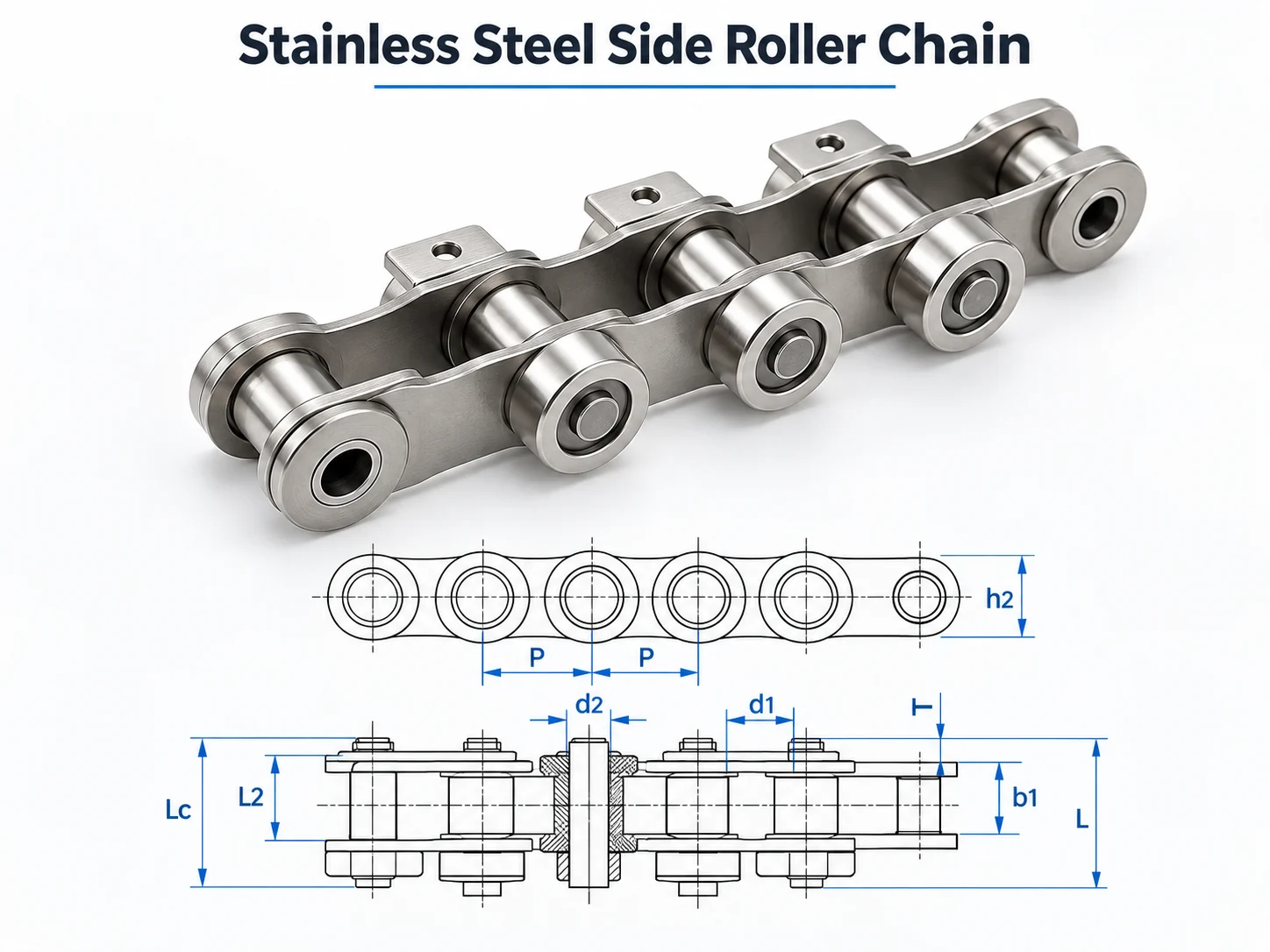
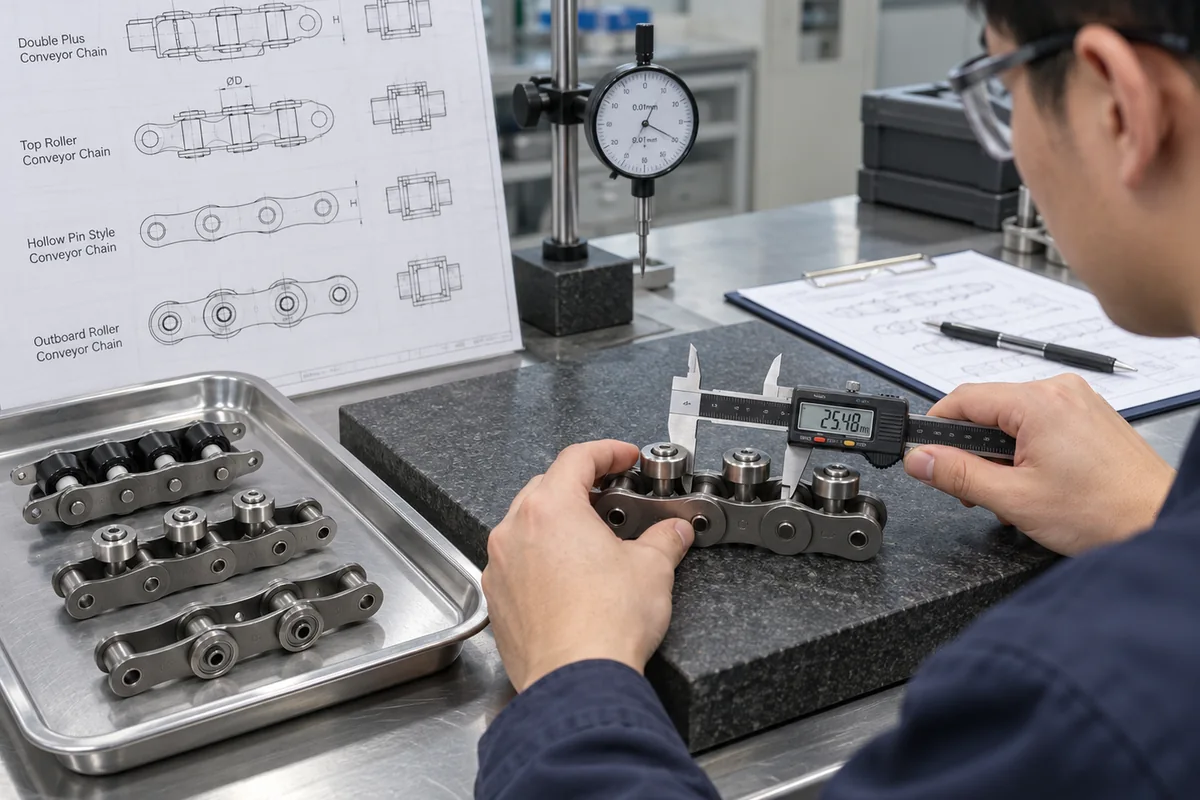
When a model number is available, use the exact model specification and the matching drawing. Compare pitch, roller diameters, inner width, pin diameter and length, plate height and thickness, and any side-roller, large-roller or hollow-pin dimensions that interface with the conveyor. When the code is unknown, measure the installed chain systematically. Measuring pitch across several pins is more reliable than reading a single worn gap, and photographs should show the side profile, roller arrangement, sprocket and rail contact.
Do not use tensile strength as the pallet payload. Catalogue tensile figures are material/component test properties. Conveyor working conditions also involve line length, the number of chain strands, carrier count, acceleration, shock, friction, lubrication, sprocket size, wear state and the required safety factor. The chain can only be verified for a system after those conditions are understood.
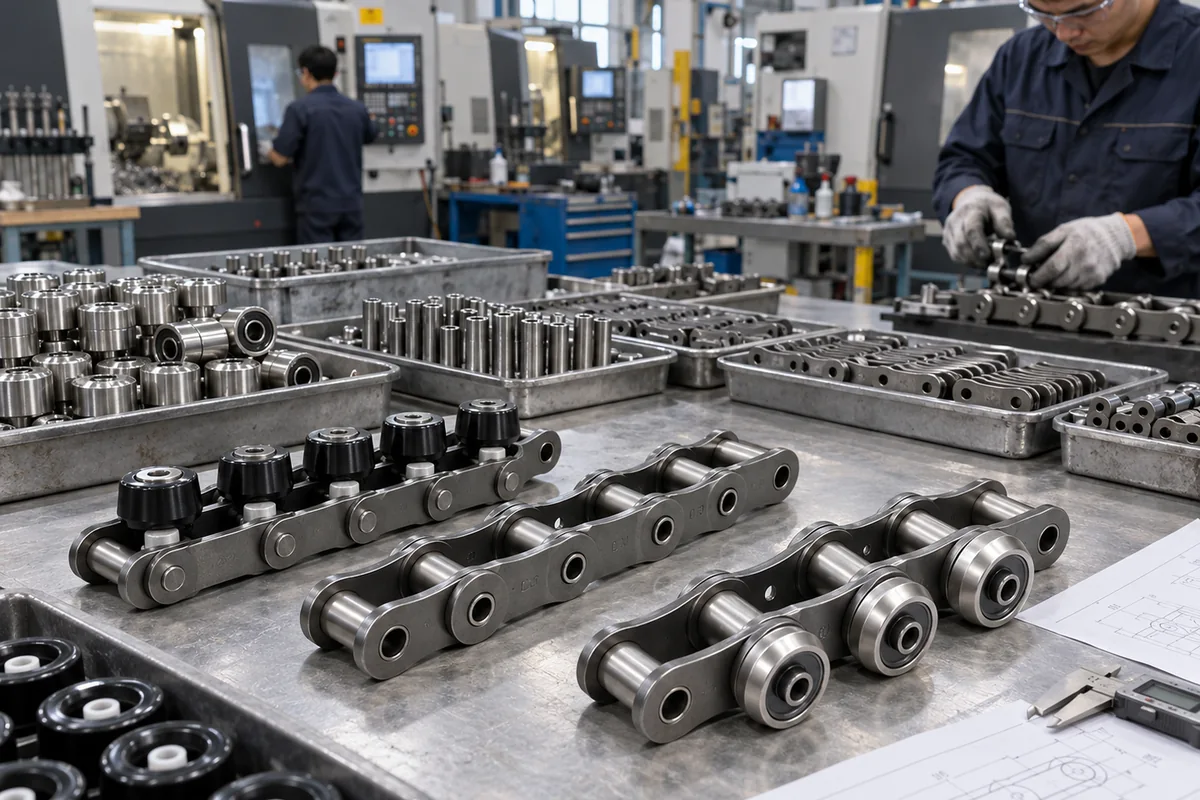
चयन कार्यप्रवाह
- Stopper Contact Point: compare the required condition with the exact chain drawing or system layout and record any open question for RFQ confirmation.
- Maximum Queue Length: compare the required condition with the exact chain drawing or system layout and record any open question for RFQ confirmation.
- Rail Friction: compare the required condition with the exact chain drawing or system layout and record any open question for RFQ confirmation.
- Restart Behavior: compare the required condition with the exact chain drawing or system layout and record any open question for RFQ confirmation.
- Carrier and duty: record loaded carrier mass, number of carriers, line speed, starts per hour, accumulation pattern and any incline or vertical transition.
- Drive and return: confirm sprocket data, shaft alignment, take-up range, return support and lubrication access.
- Release condition: list any field that the technical data does not state—such as a special material grade, coating, allowable system load or environmental rating—as an RFQ confirmation item instead of estimating it.
System integration
Once the chain is identified, check how the conveyor transfers load into the rest of the machine. The guide or wear rail should support the intended roller surface and remain continuous through joints. Parallel strands should have the specified center distance and synchronized drive timing. Stops should contact a designed pallet face, not the chain side plate. Cross transfers and lifts need enough support so the carrier does not drop into a gap or land on a pin/plate edge.
For systems that accumulate, separate transport from stopping. The chain may continue moving while the carrier is held, but the stop force, queue length, restart sequence and local friction still need to be checked. For systems that position a workpiece for processing, use dedicated locating features when the required repeatability is tighter than normal conveyor transport can provide.
Commissioning and maintenance
Commission a new or repaired conveyor at low speed first. Jog several complete chain circuits and observe the drive, return, rail transitions, stops and transfers. Listen for sounds that repeat once per chain revolution or once per sprocket rotation because those patterns help isolate a tight joint, roller damage, local rail step or sprocket issue. With rigid workpiece pallets, watch for skewing across parallel strands; even small timing differences can load one side of the carrier.
Maintenance should track trends instead of waiting for a failure. Record elongation or length checks using the approved method, inspect rollers for free rotation and abnormal flats, look for polished side-contact marks that suggest misalignment, inspect sprocket teeth and verify take-up position. Lubrication intervals should reflect the operating environment and the chain manufacturer’s guidance; more lubricant is not automatically better if it attracts abrasive contamination or enters a process area.
RFQ checklist
For a replacement request, send the model code if legible, measured pitch, roller arrangement, chain width, plate height, pin dimensions, a photograph of the side profile and a photograph showing sprocket/rail contact. For a new system, add conveyor length, carrier size and loaded mass, number of strands, strand spacing, speed, starts/stops, buffer length, environmental conditions and destination country. These details make it possible to separate a chain match from a full conveyor-duty calculation.
Design the longest queue, not only normal flow
An accumulation conveyor should be checked at its worst queue, not just with one moving carrier. Record the maximum number of stopped pallets, loaded mass, queue length, release sequence and restart frequency. Watch where sliding or rolling contact occurs while the carriers are held.
Stop design is equally important. The stop should act on a designed carrier surface and the conveyor should provide enough support around the station so that queue force does not create side loading or abrupt roller contact. Commission the line with a representative full queue before accepting the final speed and stop timing.
Measure the interface
Use several-pitch dimensions, end-view geometry and sprocket/rail details when a replacement must fit an existing machine.
Describe the duty
Include loaded carrier mass, speed, starts, accumulation or indexing behavior and the operating environment.
Test the worst case
Commission with representative carriers and the most demanding queue, stop, transfer or restart condition rather than only no-load travel.
Keep open items explicit
If a material, coating, special tolerance, documentation need or allowable system load is not stated, confirm it in the enquiry.
अक्सर पूछे जाने वाले प्रश्नों
Can I select a replacement from pitch alone?
For designing an accumulation conveyor with double plus chain, pitch is only the first filter. Confirm roller geometry, inner width, pins, plates and any side-roller or hollow-pin features against the installed conveyor before treating two chains as interchangeable.
Does a higher tensile value mean I can carry that load on the pallet?
For designing an accumulation conveyor with double plus chain, do not convert tensile strength directly into pallet payload. Service load depends on strand count, friction, acceleration, stop impact, sprockets, rails and the safety margin used for the machine.
Can a representative family photo prove the exact model?
No. A representative family image can help explain construction, but model identity and dimensions must come from the model-specific technical specification, drawing or confirmed manufacturing data.
What information speeds up a quotation?
For an RFQ related to designing an accumulation conveyor with double plus chain, send the model code or dimensional sketch, clear photographs, conveyor layout, loaded carrier information, quantity and delivery country so the review starts from reproducible machine data.
Key engineering variables for Designing an Accumulation Conveyor with Double Plus Chain
Accumulation behavior depends on roller contact, pallet underside, stop force and restart sequence, not only chain type. Record the operating case in one line: what the conveyor carries, how fast it moves, where it stops and what condition triggered the review. Capture dimensions and observations another engineer can reproduce.
| इनपुट | क्या रिकॉर्ड करना है | यह क्यों मायने रखती है |
|---|---|---|
| वाहक/भार | Loaded mass, center of gravity, underside contact and carrier count | Support, friction and stop behavior |
| गति | Speed, starts, stops, accumulation and indexing | Dynamic demand and process timing |
| Chain path | Pitch, rollers, strand spacing and rails | Mechanical fit and tracking |
| गाड़ी चलाना | Sprocket teeth, alignment, take-up and drive position | Engagement and tension distribution |
| पर्यावरण | Temperature, dust, moisture, cleaning and lubrication limits | Material and maintenance choices |
Related product and selection resources
उपयोग pallet conveyor chain catalogue to compare families and the इंजीनियरिंग चयन कार्यप्रवाह when machine data is incomplete.
What to include with an enquiry about Designing an Accumulation Conveyor with Double Plus Chain
Identify the installed or proposed chain family, quantity, application, carrier/load, key dimensions and the operating condition the new part must solve. Attach photographs or drawings when the existing code is uncertain and keep open material, documentation or delivery requirements visible.
Make the selection from interfaces, not from one catalogue dimension
A useful selection sequence starts with the carrier and rail, then moves to the chain and sprocket. Measure several pitches, identify the roller arrangement and compare plate height, pin dimensions and roller position against the drawing. Confirm the sprocket tooth count and bore and check whether the chain enters the rail smoothly after leaving the sprocket. For side-roller or hollow-pin designs, include the outboard rail or cross-rod interface in the same review. For Double Plus layouts, state the required conveying and accumulation behavior together with queue length and stop sequence. If any key dimension is unknown, leave it as an RFQ confirmation item instead of filling it from a neighboring model.
Geometry
Pitch over several joints, roller arrangement, pin/plate dimensions and strand spacing.
गाड़ी चलाना
Sprocket tooth count, bore, shaft alignment, take-up and chain entry/exit geometry.
Duty
Speed, starts per hour, maximum queue, carrier mass and environmental conditions.
Confirm the model
Compare the complete model drawing and list any unstated material, tolerance or application requirement in the enquiry.
Record both transport and accumulation conditions
When reviewing Designing an Accumulation Conveyor with Double Plus Chain, collect data from the conveyor while carriers are moving freely and again while the longest realistic queue is stopped. Record loaded carrier mass, carrier spacing, conveyor and carrier speed where available, stop position, release interval and restart sequence. Mark a carrier so its movement can be followed through the queue, and compare both strands on a dual-chain system. Photographs should show the roller/rail interface from the end as well as the chain from the side.
Use the same survey to check the drive and supporting geometry. Count sprocket teeth, record bore or shaft arrangement, note take-up position, and look for polished edges or impact marks at rail joints and transfers. If the conveyor is being modified rather than simply repaired, include the new takt time, maximum queue and any change in pallet mass. These observations make it possible to distinguish a chain-family question from a rail, stop or timing problem before parts are specified.
Free travel
Carrier speed, roller rotation, tracking and transfer support.
Queued travel
Maximum accumulation, stop contact, drag and restart behavior.
गाड़ी चलाना
Sprocket tooth count, shaft arrangement, take-up and chain entry.
Machine interface
Rail section, carrier underside, strand centers and station clearances.
Test the longest queue and the hardest restart
Accumulation design should be checked with the maximum number of carriers that can realistically queue, not only one stopped pallet. Record loaded carrier mass, queue length, stop position, release interval and the downstream station cycle that creates the queue. Observe whether rollers continue to rotate as intended and whether carriers remain square to the rails while the chain moves beneath them.
During restart, watch the first three or four carriers rather than only the lead pallet. Shock can build when clearances close simultaneously or when a transfer catches one side of the carrier. If one strand leads, inspect sprocket timing, rail elevation, take-up balance and carrier stiffness. A tension adjustment should not be used to hide a geometric problem.
For design review, combine the accumulation data with the exact chain drawing, rail section, carrier underside and drive/take-up layout. This lets the selected chain be checked against the condition that usually creates the highest friction and station force on a free-flow line.