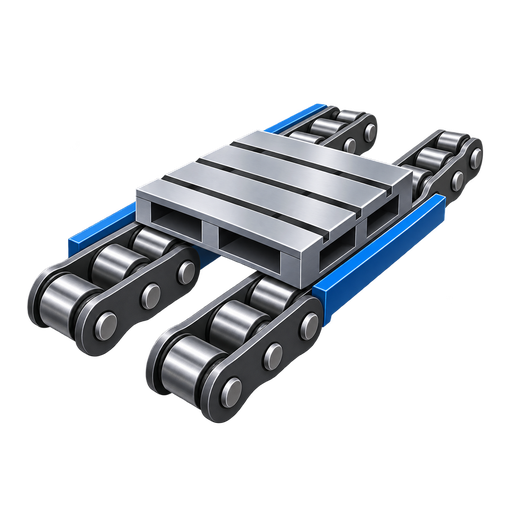
Engineering guidance for side transfers, lift-and-transfer modules and carrier handoffs between conveyor sections.
Map the carrier path before choosing a chain
Transfer points are often the most sensitive interfaces on a pallet line. Rail continuity, pallet underside geometry and the handoff between chain strands or transfer devices must be checked together. A pallet conveyor chain should be selected only after the process sequence is visible: where the carrier enters, accelerates, stops, accumulates, locates, transfers and leaves the line. The same chain family can behave very differently when the rail height, stop force, strand spacing or carrier underside changes.
Record loaded carrier mass, carrier footprint, center of gravity, conveyor length, speed, start/stop frequency and the maximum number of carriers that can occupy each zone. Include vertical or side-transfer modules, lifts, turntables and any station that applies process force while the carrier is stopped.
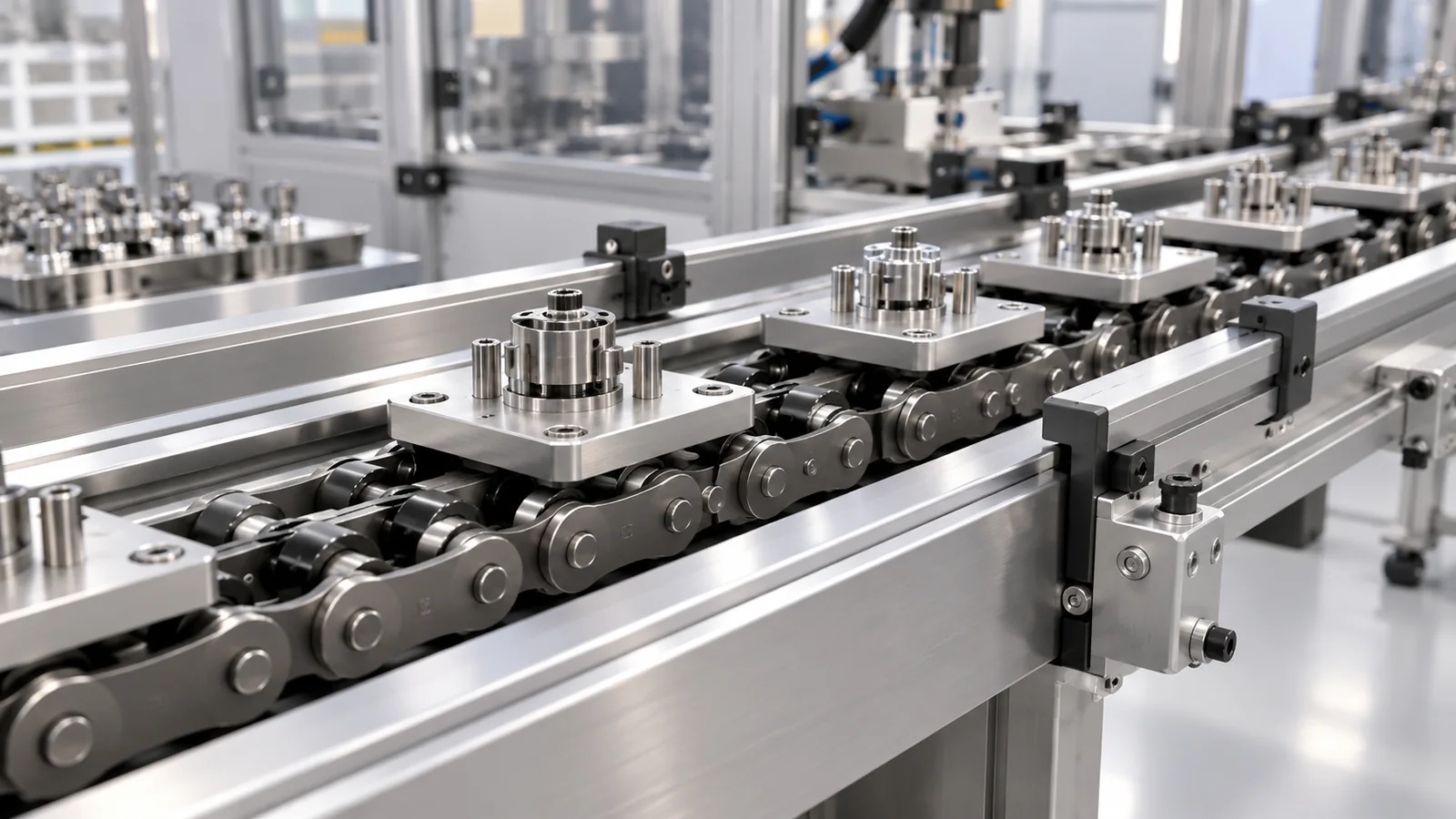
Mechanical interfaces that control the selection
Carrier underside
Define the surfaces that touch the chain or guide elements, the required datum height and any wear strip, locating bush or lift feature under the pallet.
Rail and roller contact
Confirm which roller or chain surface runs on the rail, rail material and width, return support, side guidance and clearances around transfers.
Sprocket and drive
Record pitch, tooth count, bore, shaft center distance, drive position, take-up method and how the chain transitions between sprocket and straight rail.
Stops and locators
Separate conveyor stopping forces from machining, pressing or test forces whenever possible. Identify the device that physically locates the carrier at the station.
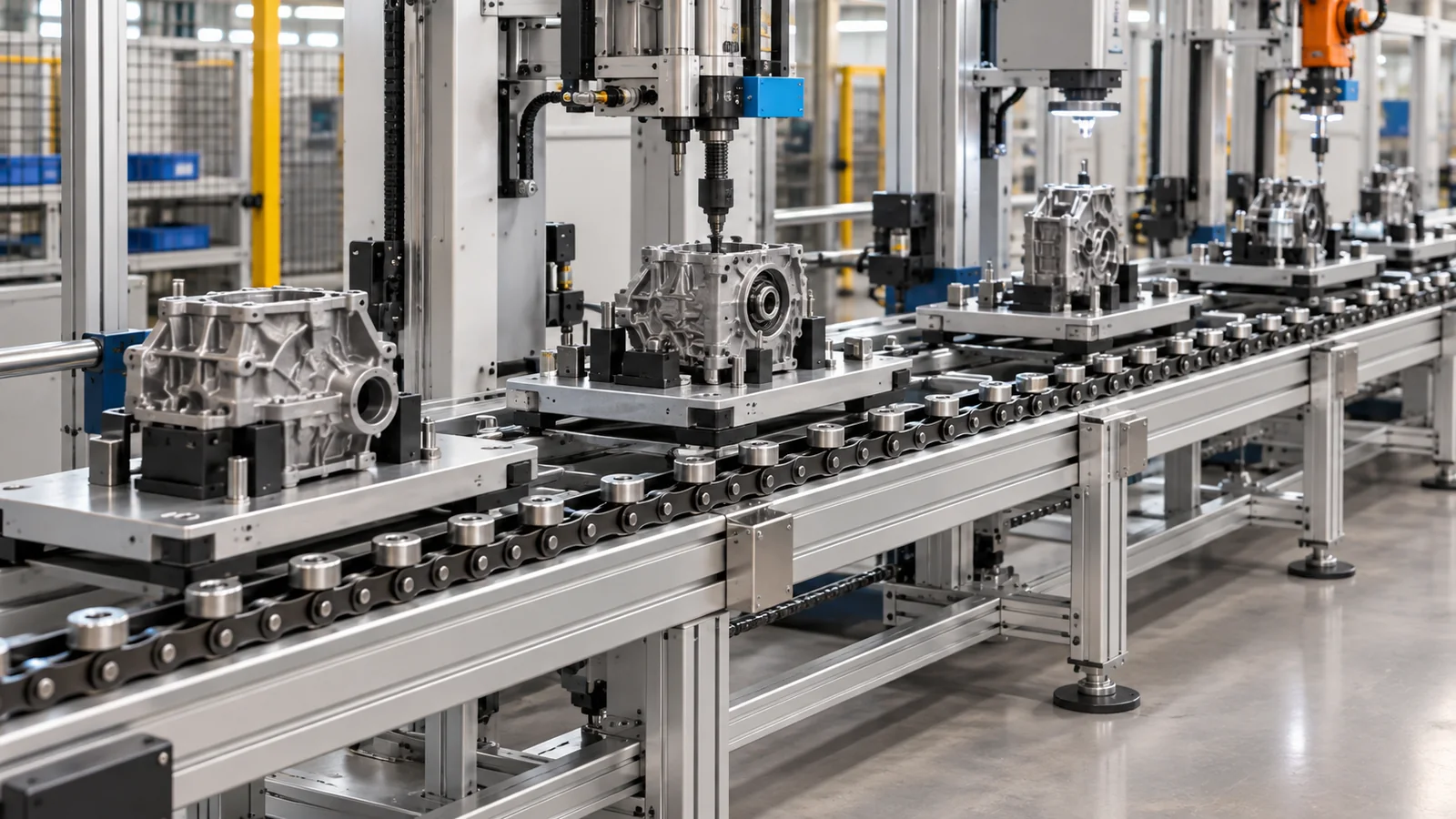
Convert the production sequence into chain duty
Line speed by itself does not describe duty. The chain also sees acceleration, loaded starts, accumulation friction, sprocket articulation, rail contact, transfer impact and environmental contamination. A short conveyor with frequent loaded starts can demand a different review from a longer line running steadily at the same nominal speed.
For accumulation or free-flow operation, provide the longest expected queue, carrier spacing and how frequently a stopped queue is released. For indexed systems, state cycle time and the number of starts per hour. For washdown, dust, abrasive particles, oils or elevated temperature, identify the environment before material or lubrication decisions are made.
Selection worksheet for Workpiece Pallet Transfer
| Input | What to record | Why it matters |
|---|---|---|
| Carrier/load | Empty and loaded mass, dimensions, center of gravity | Defines rolling load, stopping behavior and strand loading. |
| Conveyor geometry | Length, strand centers, rail section, transfers, inclines | Controls support, tracking and sprocket/rail interfaces. |
| Motion | Chain speed, carrier speed, starts per hour, accumulation | Changes friction, dynamic load and restart behavior. |
| Drive | Sprocket data, drive location, take-up and shaft alignment | Required for engagement and tension management. |
| Environment | Temperature, contamination, moisture, lubrication limits | Influences material, roller and maintenance choices. |
| Project status | New design or replacement, quantity, documentation | Determines what must be verified before quotation. |
Commissioning should prove tracking, transfers and stop behavior
Run the conveyor at low speed without production load first. Observe chain entry and exit at the sprockets, guide-rail transitions, take-up position and any side movement. Add representative carriers and confirm that rollers rotate freely, pallets do not catch at transfers and stops release cleanly without shock loading.
During loaded trials, watch the worst-case queue and the most demanding station rather than only a single carrier. Record unusual noise, roller scuffing, rail marking, uneven strand tension, chain climbing, pallet yaw and any contact between the carrier and guards or sensors. Correct geometry and alignment problems before increasing speed.

Maintenance and replacement planning
Use trend data rather than one visual snapshot. Record chain elongation over a defined number of pitches, roller condition, side-plate wear, rail wear, sprocket tooth condition and take-up position at regular intervals. If paired strands are used, compare the two sides and investigate any difference in tension or carrier tracking.
When replacing an installed chain, provide the chain code if readable, a photograph of one complete pitch from the side, an end view showing roller positions, several-pitch measurement, sprocket tooth count and bore, and the rail cross-section. If the replacement must match existing attachment timing or matched strand length, state that explicitly.
RFQ package for Workpiece Pallet Transfer
A useful request includes the machine/application, chain family or model, target pitch, carrier/load data, conveyor length and speed, quantity, sprocket details, rail interface, environment and documentation needs. For new designs, add the process sequence and pallet underside drawing. For replacement work, add installed photographs and measurements rather than relying on appearance alone.
Use the product-family catalogue to identify likely chain architectures and the engineering selection workflow to prepare dimensions. If the model is already known, link the RFQ to the relevant product page so the technical discussion stays tied to a specific configuration.
Release criteria before the conveyor enters production
Geometry released
The chain drawing, sprocket data, strand centers, rail section and carrier underside are compared as one interface. Transfer heights and guide clearances are recorded on the machine drawing rather than left as installation assumptions.
Duty released
The review uses loaded carrier mass, maximum queue, speed, starts per hour and the real stop-and-release sequence. Any washdown, dust, abrasive contamination, oil exposure or temperature constraint is stated before material and lubrication choices are closed.
Station forces released
Stops and locators are checked for the forces applied during assembly, test or handling. Where practical, process force is carried by a dedicated locating fixture instead of being reacted through the chain and guide rail.
Acceptance plan released
Commissioning observations, critical dimensions and any required inspection records are agreed before the production order. This creates a repeatable acceptance basis for purchasing, engineering and maintenance.
For a new line, the release package should include a simple carrier-flow diagram, conveyor centerline dimensions, drive and take-up location, the maximum loaded queue, transfer points and the stations where the pallet is mechanically located. For an existing line, the equivalent package is the installed chain code when readable, several-pitch measurement, side and end photographs, sprocket tooth count and bore, rail profile and the carrier underside. These records allow the chain to be reviewed against the actual machine instead of a generic application label.
After commissioning, preserve the same reference points for maintenance. Trend several-pitch elongation, roller condition, rail wear, sprocket condition and take-up position at defined intervals. A stable record makes it easier to distinguish normal wear from an alignment, lubrication or station-interface problem and gives the next replacement inquiry a reliable starting point.