Polyacetal Side Roller Chain Selection
Practical engineering guide: Polyacetal Side Roller Chain Selection. Selection, interfaces, application checks, maintenance and RFQ inputs.
This guide focuses on how to evaluate a polyacetal side-roller family from exact dimensions, rail contact and environment. It is written for machine builders, maintenance teams and buyers who need a chain selection that can be checked against drawings and the real conveyor rather than a generic product label.
Polyacetal Side Roller Chain Selection
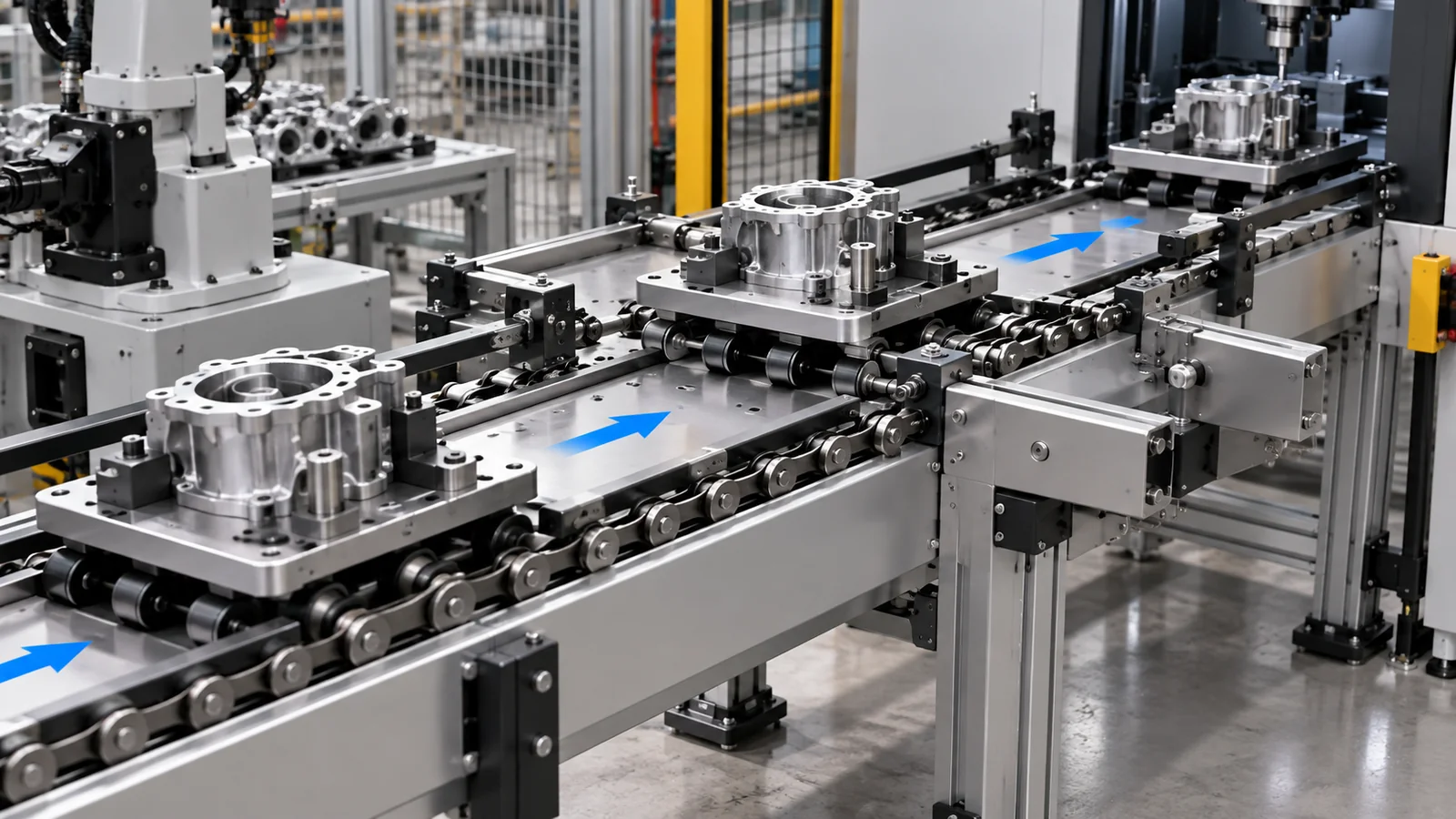
For engineering and purchasing teams, the key is to separate what the technical data proves from what the complete conveyor still needs to confirm. In a typical project such as a clean assembly conveyor with low-friction side-roller contact, chain pitch, roller contact, rail alignment, sprocket engagement, carrier stiffness, stops and maintenance access all influence the result. A useful engineering review therefore combines model-level data with the operating sequence of the machine.
Por que essa questão é importante?
How to evaluate a polyacetal side-roller family from exact dimensions, rail contact and environment affects more than catalogue selection. It changes how the workpiece carrier enters a station, how loads pass into guide rails, how the chain approaches the drive and how the system behaves during stopping or accumulation. If one interface is ignored, the symptom may appear somewhere else: a roller can wear because a rail joint is high, a chain can pull sideways because a pallet stop is offset, or a new chain can run badly because the old sprocket is worn.
The practical objective is not to eliminate every variation in the machine. It is to identify the variables that must be controlled, define which dimensions are fixed by the chain source, and leave unsupported items for explicit RFQ confirmation. This is also why claiming a polymer grade or temperature limit not stated for the selected product is a risky shortcut. It replaces measurable machine data with an assumption and can make a correct-looking part fail at installation.
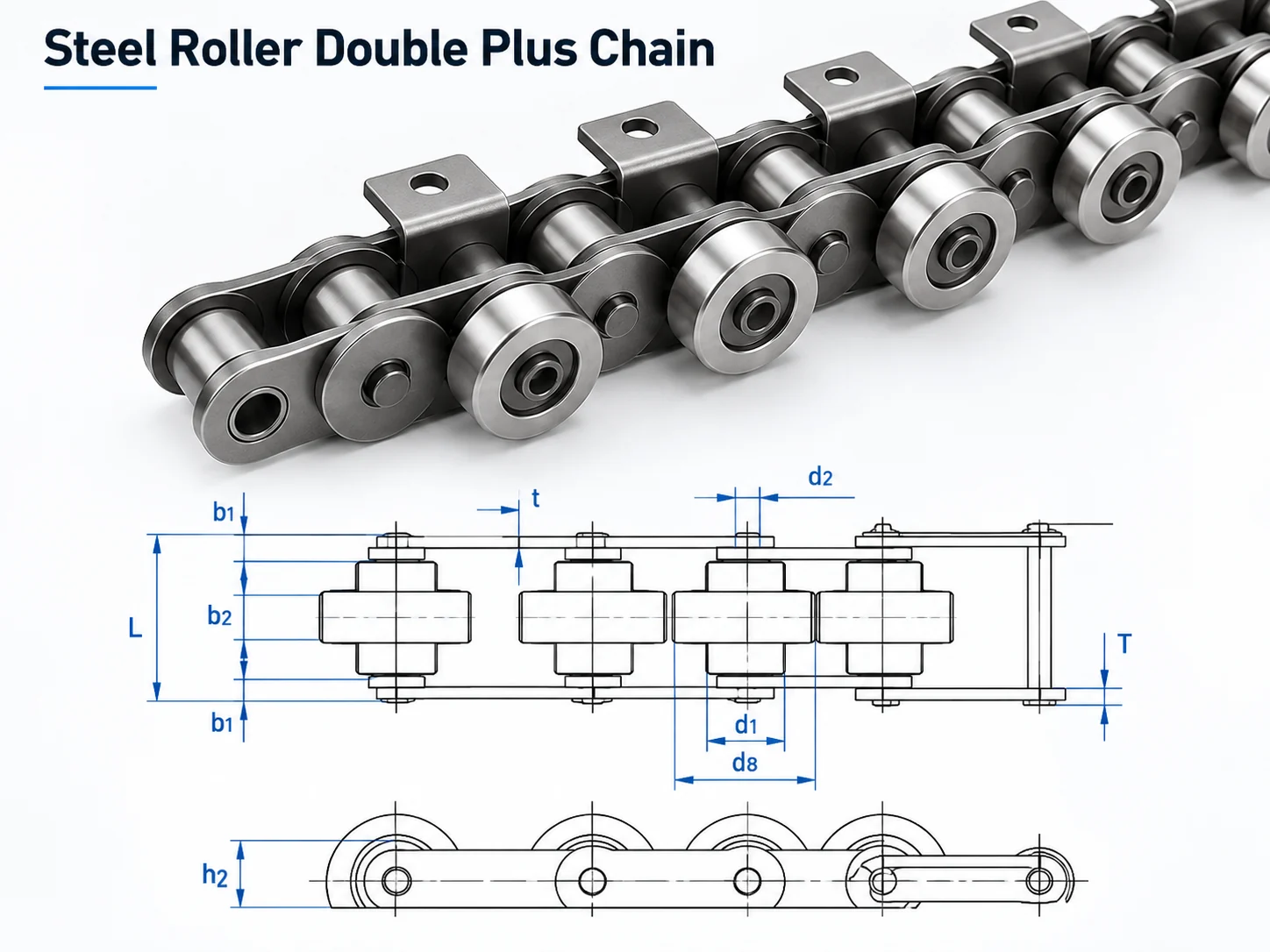
Side-roller chains are especially sensitive to the rail interface because the outboard roller position determines where support or guidance occurs. The rail should meet the intended roller surface without pushing the chain plates laterally. Keep standard-pitch, double-pitch, polymer-roller and stainless families distinct when their geometry differs; those boundaries should remain visible in the product structure.
Quatro verificações para definir primeiro
Pitch
Measure this feature from consistent reference surfaces and compare it with the exact model drawing rather than a visual match.
Side Roller Diameter
Record the relevant diameter, offset, contact surface, clearance and visible wear so the running interface can be checked.
Pin Geometry
Measure this feature from consistent reference surfaces and compare it with the exact model drawing rather than a visual match.
Operating Environment
State the real operating environment and maintenance constraints so material and lubrication choices are reviewed for the complete conveyor.
Comece com a geometria exata da corrente.
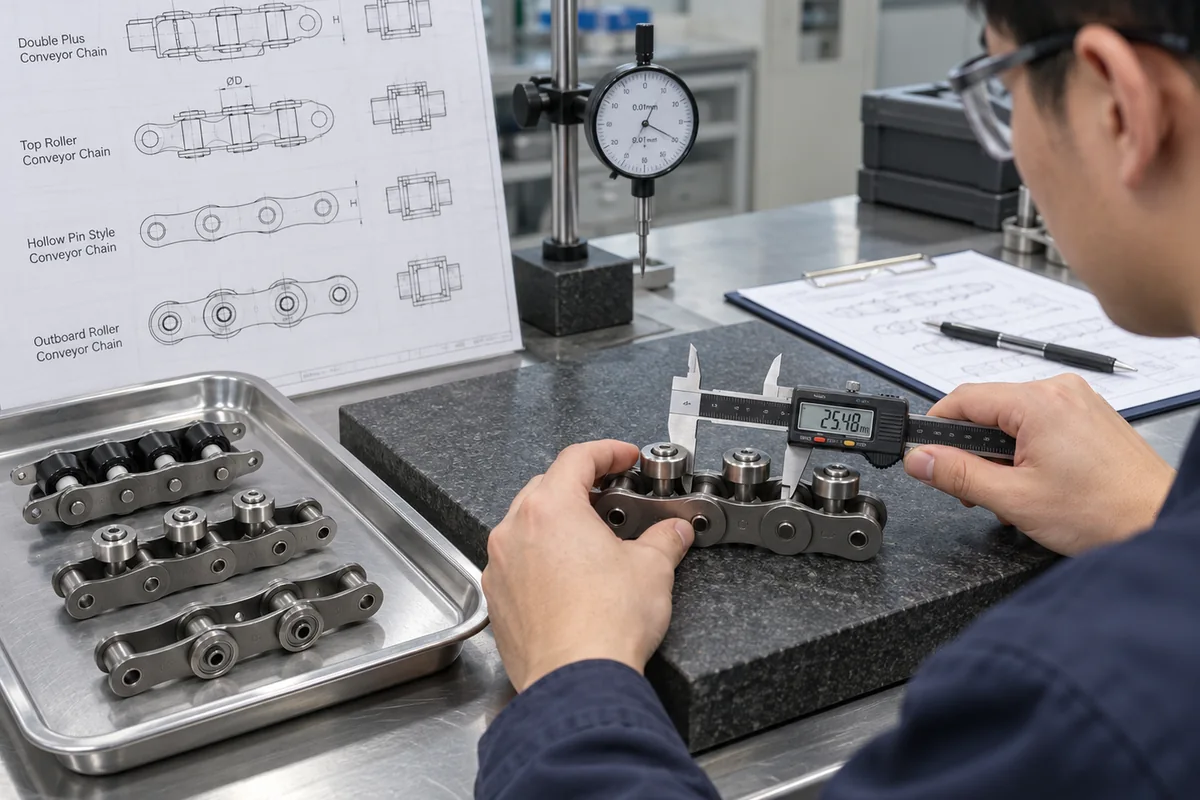
Quando o número do modelo estiver disponível, utilize a especificação exata do modelo e o desenho correspondente. Compare o passo, os diâmetros dos roletes, a largura interna, o diâmetro e o comprimento dos pinos, a altura e a espessura da placa, e quaisquer dimensões de roletes laterais, roletes grandes ou pinos ocos que interajam com a esteira transportadora. Quando o código for desconhecido, meça a corrente instalada sistematicamente. Medir o passo em vários pinos é mais confiável do que ler uma única folga desgastada, e as fotografias devem mostrar o perfil lateral, a disposição dos roletes e o contato da roda dentada com o trilho.
Do not use tensile strength as the pallet payload. Catalogue tensile figures are material/component test properties. Conveyor working conditions also involve line length, the number of chain strands, carrier count, acceleration, shock, friction, lubrication, sprocket size, wear state and the required safety factor. The chain can only be verified for a system after those conditions are understood.
Fluxo de trabalho de seleção
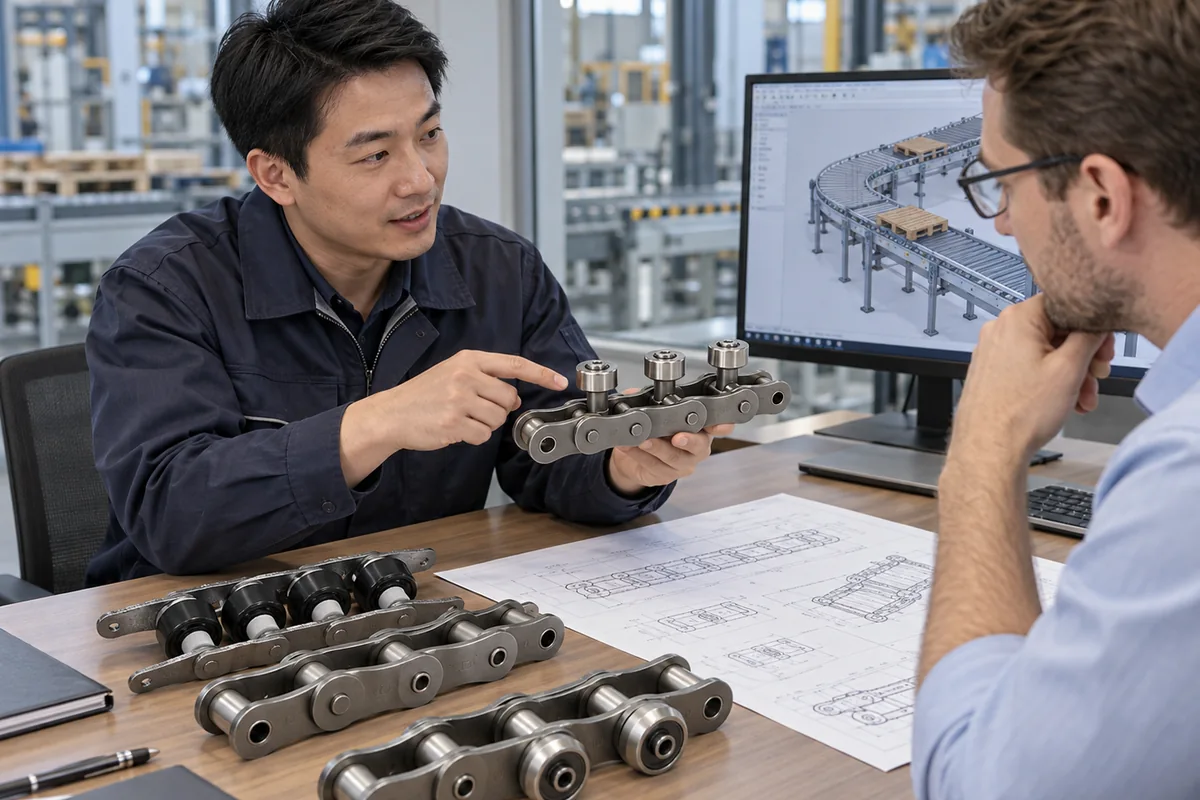
- Pitch: Compare a condição exigida com o desenho exato da cadeia ou o layout do sistema e registre quaisquer dúvidas para confirmação da solicitação de cotação.
- Side Roller Diameter: Compare a condição exigida com o desenho exato da cadeia ou o layout do sistema e registre quaisquer dúvidas para confirmação da solicitação de cotação.
- Pin Geometry: Compare a condição exigida com o desenho exato da cadeia ou o layout do sistema e registre quaisquer dúvidas para confirmação da solicitação de cotação.
- Operating Environment: Compare a condição exigida com o desenho exato da cadeia ou o layout do sistema e registre quaisquer dúvidas para confirmação da solicitação de cotação.
- Transportadora e serviço: Registre a massa do vagão carregado, o número de vagões, a velocidade da linha, as partidas por hora, o padrão de acumulação e qualquer inclinação ou transição vertical.
- Ida e volta: Confirme os dados da roda dentada, o alinhamento do eixo, a faixa de tensionamento, o suporte de retorno e o acesso à lubrificação.
- Condição de liberação: Inclua qualquer campo que os dados técnicos não especifiquem — como uma especificação especial do material, revestimento, carga admissível do sistema ou classificação ambiental — como um item de confirmação da solicitação de cotação, em vez de estimá-lo.
Integração de sistemas
Após identificar a corrente, verifique como o transportador transfere a carga para o restante da máquina. O guia ou trilho de desgaste deve suportar a superfície do rolo projetada e permanecer contínuo nas juntas. Os fios paralelos devem ter a distância entre centros especificada e a sincronização de acionamento correta. Os batentes devem entrar em contato com a face projetada do palete, e não com a placa lateral da corrente. Transferências transversais e elevações precisam de suporte suficiente para que o transportador não caia em um vão ou aterre na borda de um pino/placa.
Para sistemas de acumulação, separe o transporte da parada. A corrente pode continuar se movendo enquanto o transportador está parado, mas a força de parada, o comprimento da fila, a sequência de reinício e o atrito local ainda precisam ser verificados. Para sistemas que posicionam uma peça para processamento, utilize recursos de localização dedicados quando a repetibilidade necessária for mais precisa do que a que o transporte normal por esteira pode fornecer.
Comissionamento e manutenção
Primeiro, coloque em funcionamento uma esteira transportadora nova ou reparada em baixa velocidade. Execute vários circuitos completos da corrente e observe o acionamento, o retorno, as transições entre trilhos, as paradas e as transferências. Preste atenção a sons que se repetem uma vez por revolução da corrente ou uma vez por rotação da roda dentada, pois esses padrões ajudam a identificar problemas como juntas travadas, danos nos roletes, desníveis localizados nos trilhos ou problemas na roda dentada. Com paletes de peças rígidas, observe se há desalinhamento entre os trilhos paralelos; mesmo pequenas diferenças de tempo podem sobrecarregar um lado da esteira.
A manutenção deve monitorar tendências em vez de esperar por uma falha. Registre as verificações de alongamento ou comprimento usando o método aprovado, inspecione os roletes para verificar se giram livremente e se há superfícies planas anormais, procure por marcas de contato lateral polidas que sugiram desalinhamento, inspecione os dentes da roda dentada e verifique a posição de tensionamento. Os intervalos de lubrificação devem refletir o ambiente operacional e as orientações do fabricante da corrente; mais lubrificante não é automaticamente melhor se atrair contaminação abrasiva ou entrar em uma área de processo.
Lista de verificação da solicitação de cotação
Para um pedido de substituição, envie o código do modelo (se legível), o passo medido, a disposição dos roletes, a largura da corrente, a altura da placa, as dimensões dos pinos, uma fotografia do perfil lateral e uma fotografia mostrando o contato da roda dentada com o trilho. Para um novo sistema, adicione o comprimento do transportador, o tamanho do suporte e a massa carregada, o número de fileiras, o espaçamento entre as fileiras, a velocidade, as partidas/paradas, o comprimento do buffer, as condições ambientais e o país de destino. Esses detalhes permitem separar a compatibilidade da corrente do cálculo completo da capacidade de carga do transportador.
Check polymer roller conditions as well as geometry
The polyacetal roller identifies a material feature, not a complete service rating. Confirm roller dimensions and rail contact first, then state temperature, contamination, moisture, cleaning and lubrication conditions for the application.
If a project has a special chemical, cleanliness or electrical requirement, treat it as a system requirement to be confirmed. Keep the dimensional fit separate from environmental suitability so a visually correct replacement is not approved on incomplete information.
Measure the interface
Use several-pitch dimensions, end-view geometry and sprocket/rail details when a replacement must fit an existing machine.
Describe the duty
Include loaded carrier mass, speed, starts, accumulation or indexing behavior and the operating environment.
Test the worst case
Commission with representative carriers and the most demanding queue, stop, transfer or restart condition rather than only no-load travel.
Keep open items explicit
If a material, coating, special tolerance, documentation need or allowable system load is not stated, confirm it in the enquiry.
Perguntas frequentes
Posso selecionar um substituto apenas com base no tom?
For polyacetal side roller chain selection, pitch is only the first filter. Confirm roller geometry, inner width, pins, plates and any side-roller or hollow-pin features against the installed conveyor before treating two chains as interchangeable.
Um valor de resistência à tração mais alto significa que posso transportar essa carga no palete?
For polyacetal side roller chain selection, do not convert tensile strength directly into pallet payload. Service load depends on strand count, friction, acceleration, stop impact, sprockets, rails and the safety margin used for the machine.
Uma foto de família representativa pode comprovar que se trata do modelo exato?
Não. Uma imagem representativa da família pode ajudar a explicar a construção, mas a identidade e as dimensões do modelo devem vir da especificação técnica específica do modelo, do desenho ou dos dados de fabricação confirmados.
Que informações agilizam a elaboração de um orçamento?
For an RFQ related to polyacetal side roller chain selection, send the model code or dimensional sketch, clear photographs, conveyor layout, loaded carrier information, quantity and delivery country so the review starts from reproducible machine data.
Key engineering variables for Polyacetal Side Roller Chain Selection
Side rollers transfer support to external rails, so roller diameter, rail height and side loading need explicit checks. Record the operating case in one line: what the conveyor carries, how fast it moves, where it stops and what condition triggered the review. Capture dimensions and observations another engineer can reproduce.
| Entrada | O que gravar | Por que isso importa |
|---|---|---|
| Transportador/carga | Massa carregada, centro de gravidade, contato inferior e número de portadores | Comportamento de suporte, fricção e parada |
| Movimento | Velocidade, partidas, paradas, acumulação e indexação | Demanda dinâmica e tempo de processo |
| Caminho em cadeia | Passo, roletes, espaçamento entre os fios e trilhos | Ajuste mecânico e rastreamento |
| Dirigir | Dentes da roda dentada, alinhamento, tensionamento e posição de acionamento | Engajamento e distribuição de tensão |
| Ambiente | Limites de temperatura, poeira, umidade, limpeza e lubrificação | Opções de materiais e manutenção |
Related product and selection resources
Use o catálogo de correntes transportadoras de paletes para comparar famílias e o fluxo de trabalho de seleção de engenharia quando os dados da máquina estão incompletos.
What to include with an enquiry about Polyacetal Side Roller Chain Selection
Identifique a família de correntes instalada ou proposta, a quantidade, a aplicação, o tipo de corrente/carga, as dimensões principais e a condição operacional que a nova peça deve solucionar. Anexe fotografias ou desenhos quando o código existente for incerto e mantenha visíveis os materiais, a documentação ou os requisitos de entrega.
Make the selection from interfaces, not from one catalogue dimension
A useful selection sequence starts with the carrier and rail, then moves to the chain and sprocket. Measure several pitches, identify the roller arrangement and compare plate height, pin dimensions and roller position against the drawing. Confirm the sprocket tooth count and bore and check whether the chain enters the rail smoothly after leaving the sprocket. For side-roller or hollow-pin designs, include the outboard rail or cross-rod interface in the same review. For Double Plus layouts, state the required conveying and accumulation behavior together with queue length and stop sequence. If any key dimension is unknown, leave it as an RFQ confirmation item instead of filling it from a neighboring model.
Geometry
Pitch over several joints, roller arrangement, pin/plate dimensions and strand spacing.
Dirigir
Sprocket tooth count, bore, shaft alignment, take-up and chain entry/exit geometry.
Duty
Speed, starts per hour, maximum queue, carrier mass and environmental conditions.
Confirm the model
Compare the complete model drawing and list any unstated material, tolerance or application requirement in the enquiry.
Confirm where the polyacetal roller actually carries the load
When evaluating a polyacetal side-roller chain, verify the roller contact path on the real guide rail and the way the carrier load is transferred into that roller. The polymer roller is not a substitute for confirming chain pitch, pin geometry, plate dimensions, rail spacing and sprocket engagement. It is one part of the running interface.
For selection, send the conveyor arrangement, load per carrier, speed, duty cycle, environment and the rail section that contacts the side roller. Also identify contamination, washdown, temperature or chemical conditions that may affect the roller or surrounding components. Where those conditions are not defined by the available product data, keep them as explicit RFQ confirmation items.
Capture the special interface as well as the base chain
For Polyacetal Side Roller Chain Selection, the feature that differentiates the family must be measured directly. Side-roller chains need an end view showing roller diameter, offset and rail contact. Hollow-pin chains need pin-bore and cross-rod information, including rod span and retention. Material-specific versions also need the real operating environment stated separately from their dimensions. A nominal pitch or side photograph alone is not enough to confirm interchangeability.
Follow the special feature through the complete loop. Check rail joints, transfers, sprocket approach, return support and any location where a rod, roller or fastener could lose clearance. If two strands are connected by a carrier or cross rod, compare strand centers and take-up positions. For an RFQ, combine the exact geometry with loaded carrier information, speed, stop/queue behavior and any special material or documentation requirement; this keeps mechanical fit and application suitability visible as separate checks.
End view
Show roller offset, hollow-pin bore or attachment relationship to the chain body.
Clearance
Check rails, sprockets, return supports, guards and transfer gaps.
Load path
Identify how the carrier, fixture or cross rod transfers force.
Service condition
State environment, cleaning, lubrication and material/document requirements.
Separate environmental requirements from the dimensional match
First verify pitch, side-roller diameter and offset, plate/pin geometry, rail contact and sprocket engagement. Then document the environment: operating temperature at the machine, moisture, cleaning chemistry, contamination, lubrication restrictions and any product-contact or electrical constraints. A polymer family name alone does not prove a specific grade or service limit.
Inspect existing roller surfaces for flat spots, edge wear or embedded debris and compare those marks with rail joints. If wear is localized, correct the conveyor interface before assuming the roller material is unsuitable. On paired strands, compare contact patterns on both sides.
When requesting a replacement, send an end photograph of the chain on the rail and state any grade, compliance or documentation requirement explicitly. This keeps the mechanical fit decision grounded in measured geometry while environmental suitability remains a separate item to confirm.