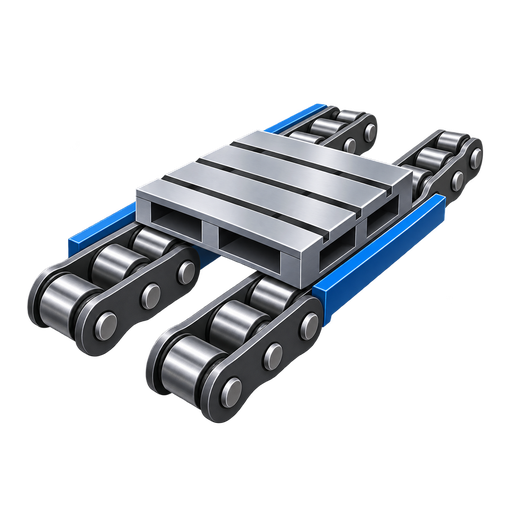
Matching Sprockets to Pallet Conveyor Chain
Practical engineering guide: Matching Sprockets to Pallet Conveyor Chain. Selection, interfaces, application checks, maintenance and RFQ inputs.
This guide focuses on how sprocket engagement, tooth geometry and chain dimensions influence smooth transfer and service life. It is written for machine builders, maintenance teams and buyers who need a chain selection that can be checked against drawings and the real conveyor rather than a generic product label.
Matching Sprockets to Pallet Conveyor Chain
For engineering and purchasing teams, the key is to separate what the technical data proves from what the complete conveyor still needs to confirm. In a typical project such as a dual-strand drive shaft synchronizing two chain lanes, chain pitch, roller contact, rail alignment, sprocket engagement, carrier stiffness, stops and maintenance access all influence the result. A useful engineering review therefore combines model-level data with the operating sequence of the machine.
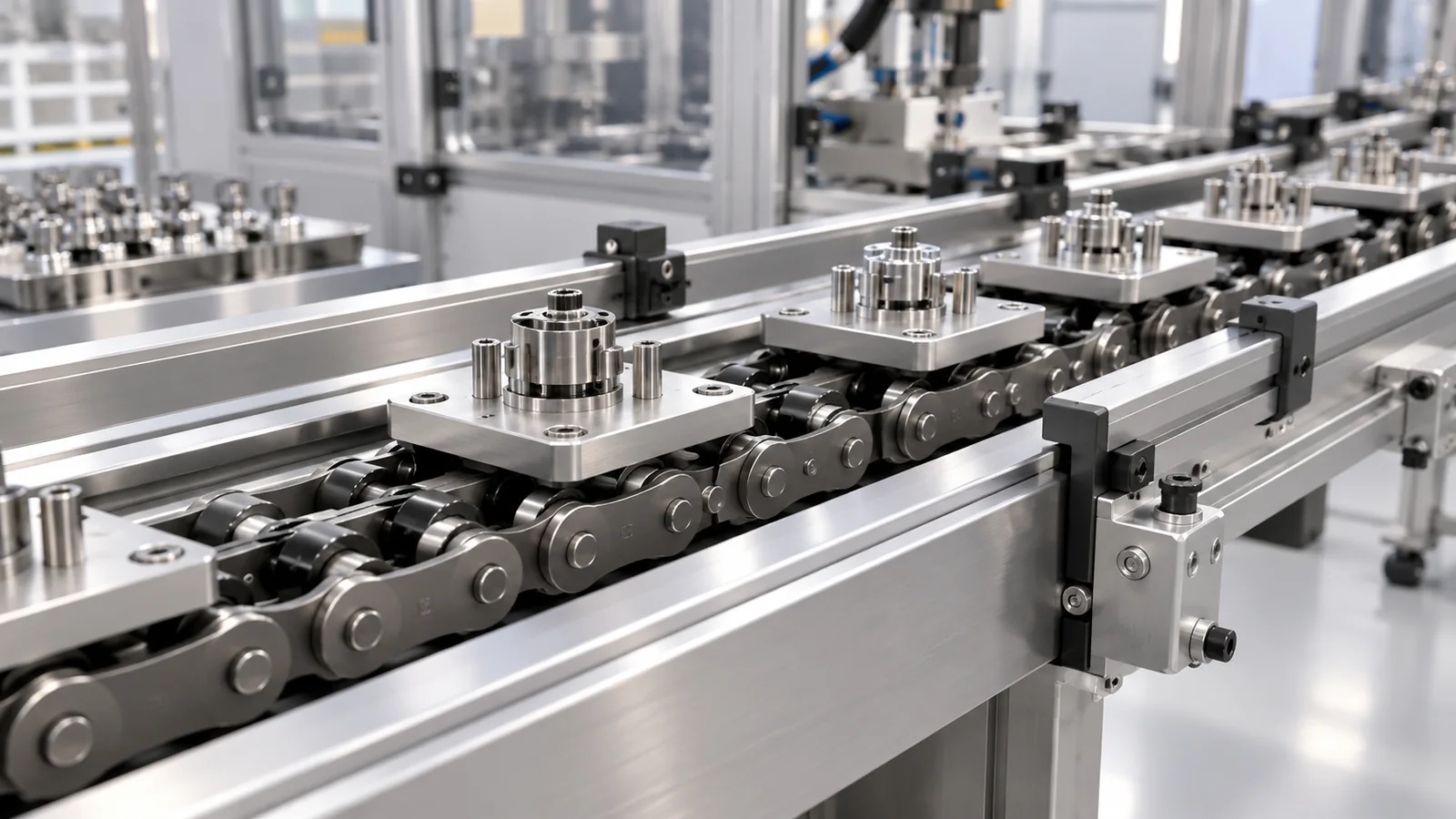
Warum dieses Thema wichtig ist
How sprocket engagement, tooth geometry and chain dimensions influence smooth transfer and service life affects more than catalogue selection. It changes how the workpiece carrier enters a station, how loads pass into guide rails, how the chain approaches the drive and how the system behaves during stopping or accumulation. If one interface is ignored, the symptom may appear somewhere else: a roller can wear because a rail joint is high, a chain can pull sideways because a pallet stop is offset, or a new chain can run badly because the old sprocket is worn.
The practical objective is not to eliminate every variation in the machine. It is to identify the variables that must be controlled, define which dimensions are fixed by the chain source, and leave unsupported items for explicit RFQ confirmation. This is also why reusing a worn or mismatched sprocket with a new chain is a risky shortcut. It replaces measurable machine data with an assumption and can make a correct-looking part fail at installation.
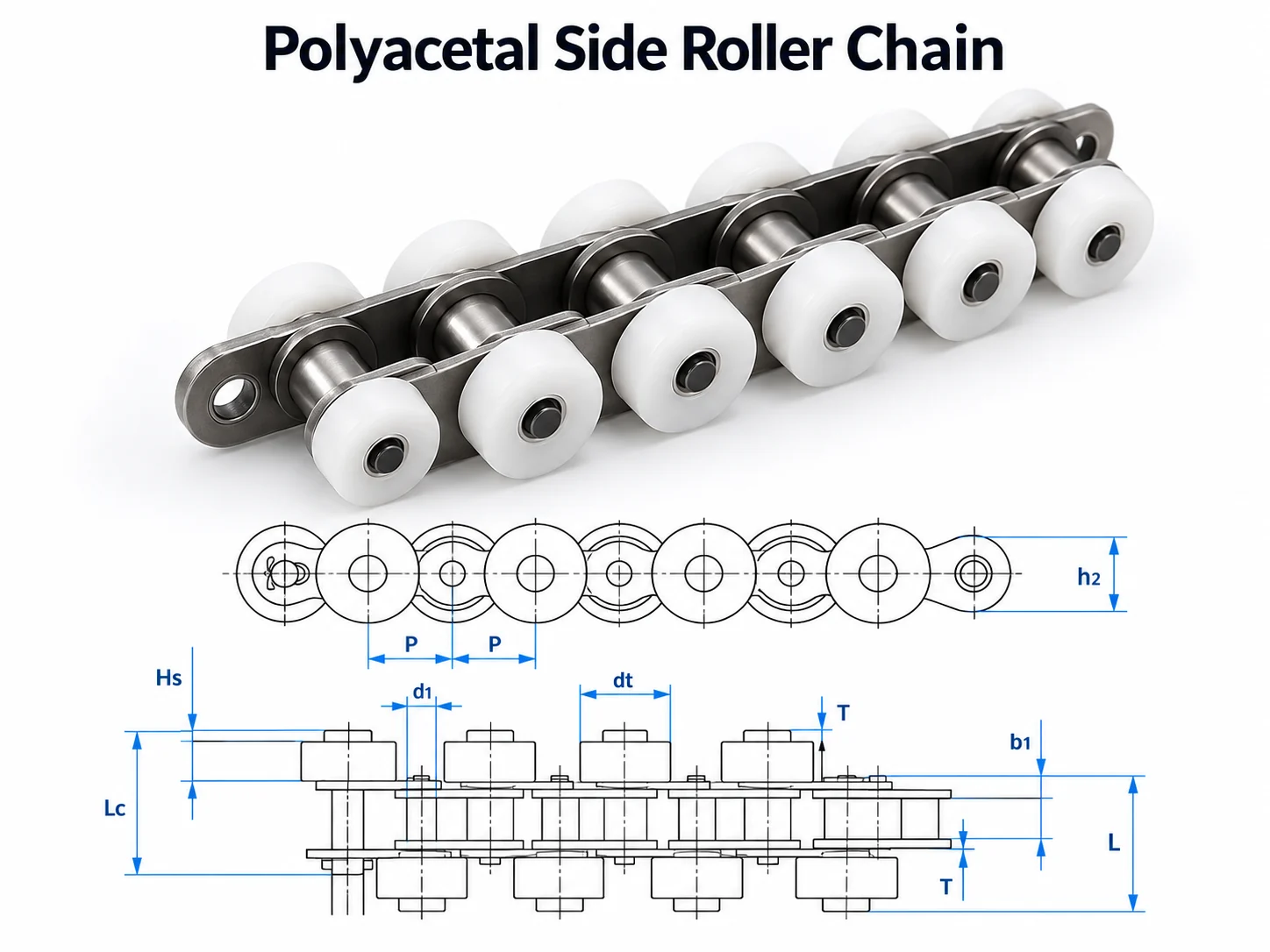
Vier Prüfungen zur Definition von ersten
Pitch Match
Measure this feature from consistent reference surfaces and compare it with the exact model drawing rather than a visual match.
Roller Diameter
Record the relevant diameter, offset, contact surface, clearance and visible wear so the running interface can be checked.
Tooth Form
State the measurable condition, installed interface and acceptance check that apply to this part of the conveyor.
Shaft Alignment
Record tooth count or drive geometry, shaft alignment, take-up position and the way the chain enters and leaves the drive.
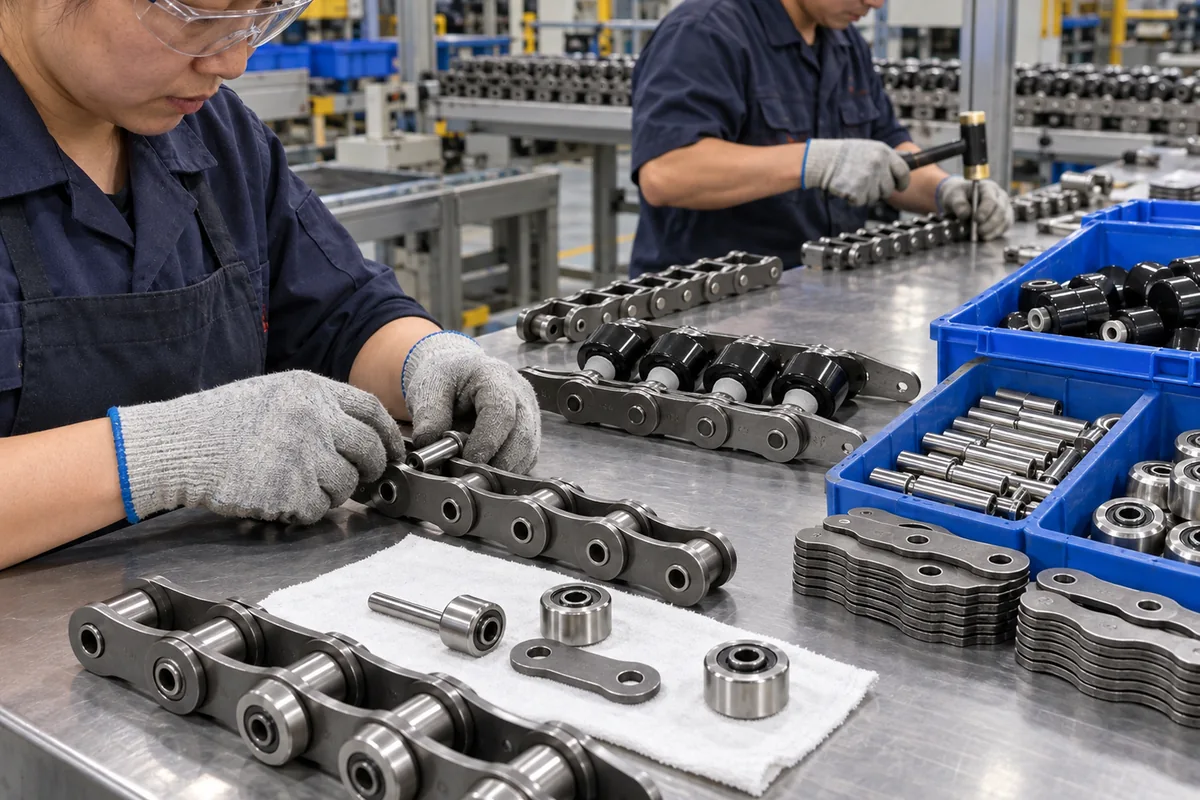
Beginnen Sie mit der exakten Kettengeometrie.
Wenn eine Modellnummer verfügbar ist, verwenden Sie die exakte Modellspezifikation und die zugehörige Zeichnung. Vergleichen Sie Teilung, Rollendurchmesser, Innenbreite, Bolzendurchmesser und -länge, Plattenhöhe und -dicke sowie alle Abmessungen von Seitenrollen, Großrollen oder Hohlbolzen, die mit dem Förderer in Kontakt stehen. Ist der Code unbekannt, messen Sie die installierte Kette systematisch. Die Messung der Teilung über mehrere Bolzen ist zuverlässiger als die Messung eines einzelnen verschlissenen Spalts. Fotos sollten das Seitenprofil, die Rollenanordnung sowie den Kontakt von Kettenrad und Schiene zeigen.
Do not use tensile strength as the pallet payload. Catalogue tensile figures are material/component test properties. Conveyor working conditions also involve line length, the number of chain strands, carrier count, acceleration, shock, friction, lubrication, sprocket size, wear state and the required safety factor. The chain can only be verified for a system after those conditions are understood.
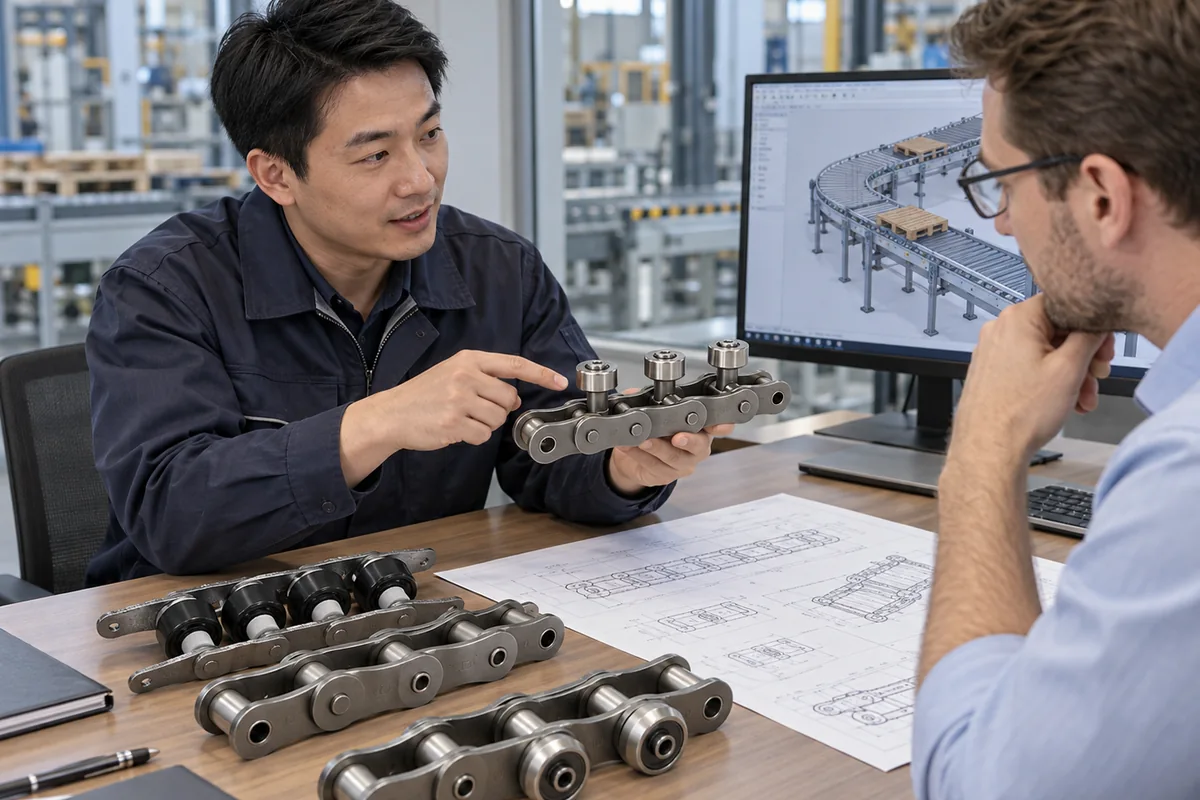
Auswahl-Workflow
- Pitch Match: Vergleichen Sie die geforderten Bedingungen mit der genauen Kettenzeichnung oder dem Systemlayout und notieren Sie alle offenen Fragen zur Bestätigung der Angebotsanfrage.
- Roller Diameter: Vergleichen Sie die geforderten Bedingungen mit der genauen Kettenzeichnung oder dem Systemlayout und notieren Sie alle offenen Fragen zur Bestätigung der Angebotsanfrage.
- Tooth Form: Vergleichen Sie die geforderten Bedingungen mit der genauen Kettenzeichnung oder dem Systemlayout und notieren Sie alle offenen Fragen zur Bestätigung der Angebotsanfrage.
- Shaft Alignment: Vergleichen Sie die geforderten Bedingungen mit der genauen Kettenzeichnung oder dem Systemlayout und notieren Sie alle offenen Fragen zur Bestätigung der Angebotsanfrage.
- Spediteur und Dienst: Erfasst werden die Masse des beladenen Förderers, die Anzahl der Förderer, die Liniengeschwindigkeit, die Starts pro Stunde, das Staumuster sowie etwaige Steigungen oder vertikale Übergänge.
- Hin- und Rückfahrt: Überprüfen Sie die Daten des Kettenrads, die Wellenausrichtung, den Spannbereich, die Rücklaufunterstützung und den Schmierzugang.
- Freigabebedingungen: Alle Felder, die in den technischen Daten nicht angegeben sind – wie z. B. eine spezielle Materialgüte, Beschichtung, zulässige Systemlast oder Umweltklasse – sollten als RFQ-Bestätigungspunkt aufgeführt werden, anstatt sie zu schätzen.
Systemintegration
Sobald die Förderkette identifiziert ist, prüfen Sie, wie die Last vom Förderband in die restliche Maschine übertragen wird. Die Führungsschiene bzw. Verschleißschiene muss die vorgesehene Rollenoberfläche stützen und an den Verbindungsstellen durchgehend sein. Parallele Kettenstränge müssen den vorgegebenen Achsabstand und die synchronisierte Antriebstaktung aufweisen. Anschläge müssen an der vorgesehenen Palettenfläche und nicht an der Kettenseitenplatte anliegen. Querübergaben und Hubvorgänge benötigen ausreichende Unterstützung, damit der Träger nicht in eine Lücke gerät oder auf einer Bolzen-/Plattenkante aufsetzt.
Bei Systemen mit Materialstau müssen Transport und Stopp getrennt werden. Die Kette kann sich weiterbewegen, während der Träger angehalten wird; Stoppkraft, Warteschlangenlänge, Wiederanlaufsequenz und lokale Reibung müssen jedoch weiterhin überprüft werden. Bei Systemen, die ein Werkstück für die Bearbeitung positionieren, sollten spezielle Positionierelemente verwendet werden, wenn die erforderliche Wiederholgenauigkeit über den Rahmen des normalen Förderbandtransports hinausgeht.
Inbetriebnahme und Instandhaltung
Nehmen Sie ein neues oder repariertes Förderband zunächst mit niedriger Geschwindigkeit in Betrieb. Führen Sie mehrere vollständige Kettenumläufe durch und beobachten Sie dabei Antrieb, Rücklauf, Schienenübergänge, Stopps und Materialübergaben. Achten Sie auf Geräusche, die sich einmal pro Kettenumdrehung oder Kettenradumdrehung wiederholen, da diese Muster Hinweise auf schwergängige Verbindungen, beschädigte Rollen, lokale Schienenstufen oder Probleme mit den Kettenrädern geben. Bei starren Werkstückpaletten ist auf Schräglagen zwischen parallelen Strängen zu achten; selbst geringe Timing-Unterschiede können zu einseitiger Belastung des Förderers führen.
Die Instandhaltung sollte Trends verfolgen, anstatt auf einen Ausfall zu warten. Längen- und Dehnungsmessungen sind gemäß der zugelassenen Methode zu dokumentieren. Die Rollen sind auf freie Drehung und ungewöhnliche Abflachungen zu prüfen. Polierte Seitenkontaktspuren, die auf eine Fehlausrichtung hindeuten, sind zu erkennen. Die Kettenradzähne sind zu prüfen und die Spannposition zu verifizieren. Die Schmierintervalle sollten sich nach den Betriebsbedingungen und den Empfehlungen des Kettenherstellers richten; mehr Schmierstoff ist nicht automatisch besser, wenn er abrasive Verunreinigungen anzieht oder in einen Prozessbereich gelangt.
Checkliste für Angebotsanfragen
Für eine Ersatzteilanfrage senden Sie bitte, falls lesbar, die Modellbezeichnung, die gemessene Teilung, die Rollenanordnung, die Kettenbreite, die Plattenhöhe, die Bolzenabmessungen, ein Foto des Seitenprofils und ein Foto, das den Kontakt zwischen Kettenrad und Schiene zeigt. Für eine neue Anlage benötigen wir zusätzlich die Förderbandlänge, die Trägergröße und die Ladungsmasse, die Anzahl der Litzen, den Litzenabstand, die Geschwindigkeit, die Start-/Stopp-Zeiten, die Pufferlänge, die Umgebungsbedingungen und das Zielland. Diese Angaben ermöglichen es, die Kettenanpassung von der Berechnung der Gesamtförderleistung zu trennen.
Verify engagement at the drive and return
A chain replacement should be checked against the actual sprocket rather than only a nominal pitch. Record tooth count, bore, hub arrangement, shaft position and visible tooth wear. Observe how the chain enters and exits the sprocket and whether the roller seats cleanly without climbing or impact.
If both chain and sprocket are being replaced, retain the original center-distance and guarding constraints in the review. If only the chain is being changed, inspect the old sprocket carefully; a worn tooth form can make a new chain appear defective even when the chain dimensions are correct.
Measure the interface
Use several-pitch dimensions, end-view geometry and sprocket/rail details when a replacement must fit an existing machine.
Describe the duty
Include loaded carrier mass, speed, starts, accumulation or indexing behavior and the operating environment.
Test the worst case
Commission with representative carriers and the most demanding queue, stop, transfer or restart condition rather than only no-load travel.
Keep open items explicit
If a material, coating, special tolerance, documentation need or allowable system load is not stated, confirm it in the enquiry.
Häufig gestellte Fragen
Kann ich einen Ersatz nur anhand der Tonhöhe auswählen?
For matching sprockets to pallet conveyor chain, pitch is only the first filter. Confirm roller geometry, inner width, pins, plates and any side-roller or hollow-pin features against the installed conveyor before treating two chains as interchangeable.
Bedeutet ein höherer Zugfestigkeitswert, dass ich diese Last auf der Palette tragen kann?
For matching sprockets to pallet conveyor chain, do not convert tensile strength directly into pallet payload. Service load depends on strand count, friction, acceleration, stop impact, sprockets, rails and the safety margin used for the machine.
Kann ein repräsentatives Familienfoto das genaue Modell beweisen?
Nein. Ein repräsentatives Familienbild kann zwar zur Erläuterung der Konstruktion beitragen, die Modellidentität und die Abmessungen müssen jedoch aus der modellspezifischen technischen Spezifikation, der Zeichnung oder den bestätigten Fertigungsdaten stammen.
Welche Informationen beschleunigen die Angebotserstellung?
For an RFQ related to matching sprockets to pallet conveyor chain, send the model code or dimensional sketch, clear photographs, conveyor layout, loaded carrier information, quantity and delivery country so the review starts from reproducible machine data.
Key engineering variables for Matching Sprockets to Pallet Conveyor Chain
Sprocket pitch, tooth profile, bore, alignment and wear state control engagement and must be checked with the chain. Record the operating case in one line: what the conveyor carries, how fast it moves, where it stops and what condition triggered the review. Capture dimensions and observations another engineer can reproduce.
| Eingang | Was aufgezeichnet werden soll | Warum es wichtig ist |
|---|---|---|
| Träger/Ladung | Beladene Masse, Schwerpunkt, Unterseitenkontakt und Trägeranzahl | Unterstützung, Reibung und Stoppverhalten |
| Bewegung | Geschwindigkeit, Starts, Stopps, Akkumulation und Indexierung | Dynamische Nachfrage und Prozesszeitplanung |
| Kettenpfad | Teilung, Rollen, Litzenabstand und Schienen | Mechanische Passform und Nachführung |
| Fahren | Kettenradzähne, Ausrichtung, Spann- und Antriebsposition | Engagement und Spannungsverteilung |
| Umfeld | Grenzwerte für Temperatur, Staub, Feuchtigkeit, Reinigung und Schmierung | Material- und Wartungsoptionen |
Related product and selection resources
Verwenden Sie die Katalog für Palettenförderketten um Familien und die Auswahlprozess für Ingenieure when machine data is incomplete. For adjacent component context, see roller-chain sprocket configurations.
What to include with an enquiry about Matching Sprockets to Pallet Conveyor Chain
Geben Sie die installierte oder geplante Kettenfamilie, die Anzahl, die Anwendung, das Träger-/Lastsystem, die wichtigsten Abmessungen und die Betriebsbedingungen an, die das neue Bauteil erfüllen muss. Fügen Sie Fotos oder Zeichnungen bei, wenn die geltenden Normen unklar sind, und halten Sie offene Material-, Dokumentations- oder Lieferanforderungen offen.
Make the selection from interfaces, not from one catalogue dimension
A useful selection sequence starts with the carrier and rail, then moves to the chain and sprocket. Measure several pitches, identify the roller arrangement and compare plate height, pin dimensions and roller position against the drawing. Confirm the sprocket tooth count and bore and check whether the chain enters the rail smoothly after leaving the sprocket. For side-roller or hollow-pin designs, include the outboard rail or cross-rod interface in the same review. For Double Plus layouts, state the required conveying and accumulation behavior together with queue length and stop sequence. If any key dimension is unknown, leave it as an RFQ confirmation item instead of filling it from a neighboring model.
Geometry
Pitch over several joints, roller arrangement, pin/plate dimensions and strand spacing.
Fahren
Sprocket tooth count, bore, shaft alignment, take-up and chain entry/exit geometry.
Duty
Speed, starts per hour, maximum queue, carrier mass and environmental conditions.
Confirm the model
Compare the complete model drawing and list any unstated material, tolerance or application requirement in the enquiry.
Verify the installed sprocket as a mating component
A replacement chain should not be approved from chain pitch alone when the existing sprocket is part of the problem. Record tooth count, bore and hub arrangement, shaft position and visible tooth wear, then compare those observations with the chain drawing. On paired-strand conveyors, also confirm that the two sprockets are aligned and timed so one strand is not forced to lead the other through transfers or stops.
Useful RFQ material includes a straight-on photograph of the sprocket, a side view showing the hub, measured shaft or bore data and the chain model or dimensions. If the existing sprocket profile is damaged or uncertain, treat sprocket replacement as part of the engineering review rather than assuming the new chain will correct the engagement condition.
Measure the interfaces that control fit and tracking
For Matching Sprockets to Pallet Conveyor Chain, start with a dimensioned record of the installed conveyor. Measure several pitches rather than one joint, then add roller or pin geometry, plate dimensions, strand centers and the rail/contact section. At the drive, record sprocket tooth count, bore or shaft arrangement and visible tooth wear. At stations, identify stop faces, locators, transfer gaps and the carrier surfaces that actually touch the conveyor.
Repeat the review with a representative loaded pallet at safe low speed. Watch whether the carrier stays square, whether both strands share the load and whether any symptom begins at the same fixed location. A change tied to one rail joint, stop or sprocket should be corrected at that interface before chain tension or a new chain is used as the remedy. Keep photographs of the measurement reference points with the RFQ so an engineer can reproduce the comparison against the proposed drawing.
Chain geometry
Several-pitch length plus roller, pin, plate and attachment dimensions.
Carrier geometry
Loaded mass, underside supports, datums, center of gravity and stop faces.
Drive geometry
Sprocket, shaft, center distance and available take-up travel.
Fixed locations
Rail joints, transfers, stops and points with recurring wear or impact.
Inspect the used sprocket before judging a new chain
Clean enough of the drive sprocket to see the tooth form, then record tooth count, bore, hub arrangement and shaft position. Look for hooked teeth, uneven polishing or evidence that the chain is riding high. A worn sprocket can make a correctly dimensioned replacement chain run noisily or appear to have the wrong pitch.
With the conveyor at safe low speed, watch chain entry and exit at the sprocket. The rollers should seat without climbing or striking the tooth tip. Compare both sides of a dual-strand drive and check shaft alignment. If the chain lifts on only one side, investigate sprocket timing, rail approach and bearing position before altering chain tension.
When both chain and sprocket are to be replaced, include center distance, guarding limits and take-up travel. When only the chain is being changed, provide photographs of the existing sprocket teeth with the chain installed. That helps separate a chain-fit question from a worn-drive question.